Authored By: Neha, University Institute of Legal Studies, Panjab University, Chandigarh, Research Writer at Law Audience®,
Edited By: Mr. Varun Kumar, Advocate, Himachal, Punjab & Haryana and Founder at Law Audience.
Introduction
A society shows its true character by how it treats its children, especially those who err. Are they punished like criminals, or helped to grow into better people? India’s approach has changed over thousands of years. It has been shaped by ancient wisdom, colonial rules, constitutional laws, and serious crimes that forced the country to face difficult realities.
This is the story of that evolution.
Part I: Ancient Roots
Hindu Law and the Wisdom of Manusmriti
Long before modern psychology coined terms like “cognitive development,” ancient Hindu jurisprudence had already grasped a fundamental truth: a child’s mind is not an adult’s mind.
The Manusmriti, one of the oldest codified legal texts in the world, drew clear age-based distinctions. A child below 8 years of age was considered practically equivalent to “a child in the womb” — incapable of legal or moral culpability. The reasoning was grounded in the concept of Viveka — the power to discriminate between right and wrong. Without Viveka, there could be no intent, and without intent, there could be no crime.
Children between 8 and 16 years occupied a middle ground. They were considered partially responsible but spared from severe punishments. Reformative measures like admonition and minor discipline were preferred. Only those above 16 were treated as fully accountable adults.
Key provisions from Chapter 8 of the Manusmriti reflect this thinking clearly:
- The King was designated the legal guardian of a minor’s property (Verse 27).
- A minor was disqualified as a witness (Verse 70).
- Courts were directed to consider age and capacity before sentencing (Verse 126).
- Contracts made by children were declared void (Verse 163).
These were not merely philosophical positions — they were binding legal principles in their time.
Islamic Law and the Mercy of Sharia
Muslim jurisprudence similarly protected children from punitive consequences. Under Sharia, any act by a child below 7 years was not considered a crime at all. Even approaching puberty was not automatically treated as a threshold for full legal responsibility.
The celebrated saying attributed to Prophet Mohammad draws a powerful parallel: there is no legal obligation on “one who is sleeping until he wakens, a child until he becomes an adult, and one who is insane until he becomes sane.” In this formulation, childhood is placed alongside unconsciousness and incapacity — states in which the law must show restraint.
Retributive punishments (Hadd) were categorically withheld from children until maturity was established. Correctional alternatives — restitution, admonition, light disciplinary measures — were the norm.
What is striking about both these ancient traditions is how closely they align with what modern science now confirms: young brains are structurally and neurologically different, making full moral culpability unjust before a certain developmental stage.
Part II: The Colonial Period — Reform Meets Repression
The Ragged Schools (1843)
The British colonial era brought with it imported concepts of child welfare, some more enlightened than others. The first formal centre for children in distress on Indian soil was established in 1843 during Lord Cornwallis’s tenure — inspired by the “Ragged School” movement from Britain, which focused on education and care for destitute children. The Ragged School Union, formalized in 1844, laid the groundwork for charitable child welfare in the colonial framework.
The Apprentices Act, 1850
This was the first English law to formally deal with children in conflict with the law in India. Children between 10 and 18 years who committed petty offences could be bound as apprentices for up to 7 years (ending at age 21, or upon marriage for females). The idea was simple but significant: redirect the energy of young offenders from criminal influence toward productive work. Punishment was secondary; livelihood and rehabilitation came first.
The Whipping Act, 1864
Not all colonial thinking was progressive. Amidst debates between punishers and rehabilitators, the Whipping Act emerged as a compromise — physically disciplining juveniles and then releasing them, with the stated hope that the experience would deter repetition. It was crude, but it reflected the tension between punishment and reform that would define juvenile justice debates for the next century.
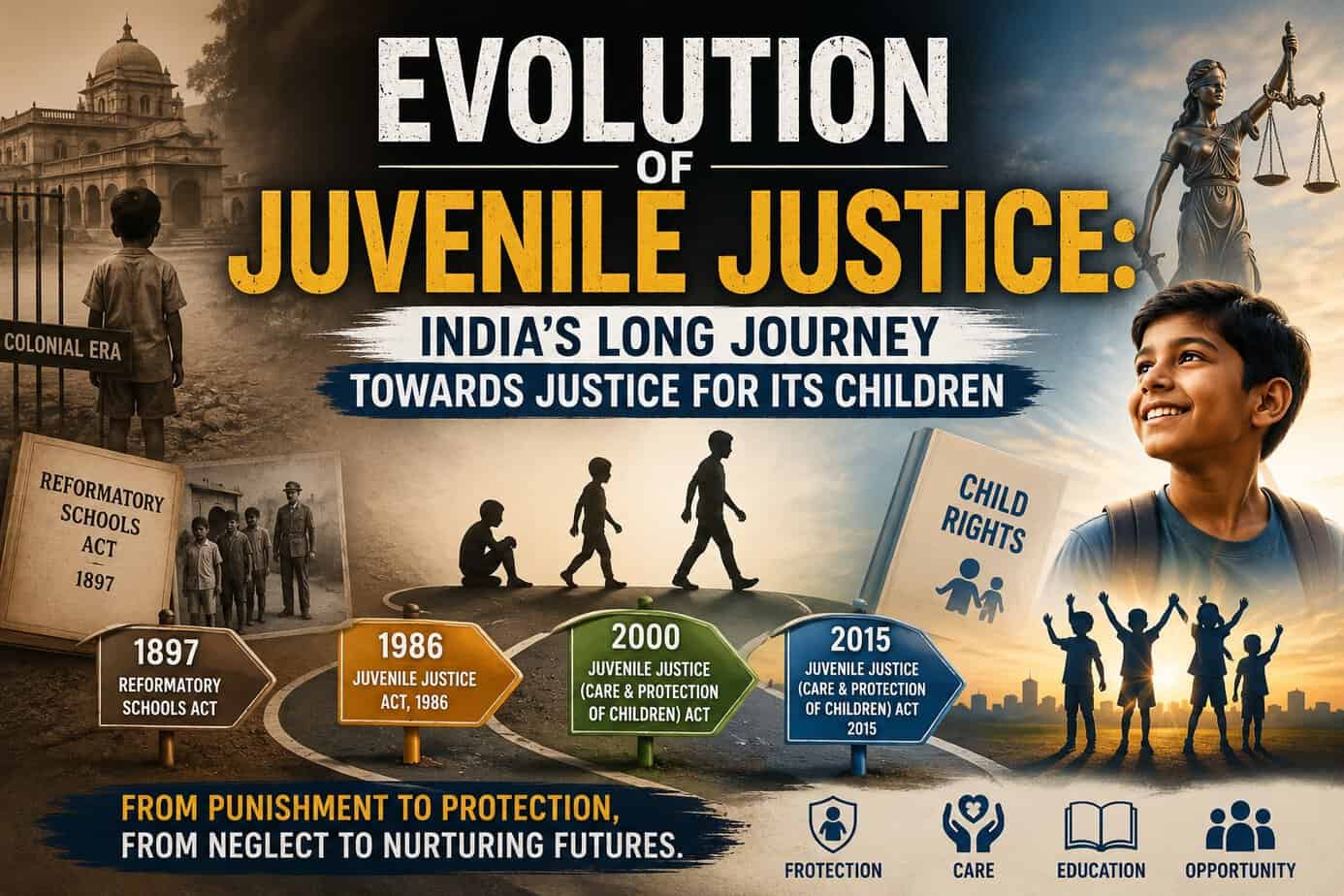
The Reformatory Schools Acts (1876 and 1897)
A more constructive approach followed. The Reformatory Schools Act of 1876 directed that “Youthful Offenders” — boys under 15 who had been imprisoned or transported — be sent to dedicated reformatory institutions instead. Sentences ranged from 3 to 7 years.
The 1897 revision refined this further, introducing the option of judicial discharge after “due admonition” or release to parents under a bond of good conduct. Notably, however, these protections covered only male juveniles between 7 and 15 years — female juveniles remained largely outside the protective framework of the law.
The Indian Penal Code, 1860
Running parallel to these special laws, the IPC codified the ancient principle of doli incapax (incapable of crime) into modern statutory form:
- Section 82: Absolute immunity for children below 7 years of age — no act could constitute an offence.
- Section 83: Children between 7 and 12 years were protected from prosecution unless they had attained sufficient maturity to understand the nature and consequences of their actions.
These provisions remain relevant today, mirrored in Sections 20 and 21 of the Bharatiya Nyaya Sanhita (BNS), 2023.
The Indian Jail Committee Recommendations, 1920
The Indian Jail Committee of 1920 marked a pivotal shift in official thinking. Its recommendations were ahead of their time: establish special remand homes to prevent juveniles from being detained alongside adult criminals; ban imprisonment for children under 14; and make bail compulsory for all juvenile cases. These recommendations seeded the ground for provincial Children Acts.
Following this, the Children Act of 1920 was enacted by the Madras High Court, followed by Bengal (1922) and Bombay (1924) — the first wave of formal juvenile justice legislation in India.
Part III: Post-Independence Foundations — The Constitution and Early Legislation
A Constitution That Cares for Children
India’s Constitution, adopted in 1950, embedded child welfare into its very architecture. Key provisions include:
- Article 15(3) — empowers the State to make special provisions for women and children.
- Article 21A — guarantees free and compulsory education to children aged 6 to 14 years (inserted by the 86th Amendment, 2002).
- Article 39(f) — directs the State to ensure children are given opportunities for healthy development in conditions of freedom and dignity, and that they are protected from exploitation.
- Article 45 — originally mandated free and compulsory education for all children up to age 14.
- Article 47 — places on the State the duty to raise the standard of nutrition and public health.
These provisions were not merely aspiration — they created a constitutional obligation to build a juvenile justice system that prioritized care over punishment.
The Children Act, 1960
The Union Government’s Children Act of 1960, applicable to Union Territories, formalized the post-independence framework. For the first time, a distinction was statutorily drawn between:
- A Neglected Child — destitute, begging, without a home, or living in harmful environments.
- A Delinquent Child — one who has committed an offence.
The Act prohibited jail sentences and police lockups for children, directing instead that they be sent to Observation Homes, Children’s Homes, or Special Schools. It defined “child” as boys under 16 and girls under 18 — a gendered distinction that would persist until the 21st century. This Act served as the foundational blueprint for the more comprehensive legislation that would follow.
Part IV: The Uniform National Framework — JJ Acts of 1986 and 2000
Juvenile Justice Act, 1986
India’s first national, uniform framework for juvenile justice arrived in 1986, replacing the patchwork of state-level Children Acts. Aligned with the UN Declaration of the Rights of Children (1959) and the UN Standard Minimum Rules for the Administration of Juvenile Justice (1985) — also known as the Beijing Rules — the Act established a formally rehabilitative architecture:
- Juvenile Courts for delinquent children; Juvenile Welfare Boards for neglected children.
- Juvenile Homes for neglected juveniles; Welfare Homes for delinquents.
- Observation Homes for cases pending inquiry; Aftercare Homes for children after discharge.
- Maximum punishment for convicted delinquents: 3 years — no execution, no imprisonment in regular jails.
- Section 36 prohibited media publication of a juvenile’s name, address, or photograph to prevent social stigma.
Yet the Act had serious gaps. The definition of “juvenile” remained discriminatory by sex — a boy was a juvenile until 16, a girl until 18. Separate trials for neglected and delinquent children were mandated but often ignored in practice. Most critically, when the UN Convention on the Rights of the Child was adopted in 1989 and India ratified it in 1992, the 1986 Act’s inadequacies became impossible to ignore.
Juvenile Justice (Care and Protection of Children) Act, 2000
The JJ Act of 2000 was a generational upgrade. Among its most important changes:
- Standardized the definition: “child” or “juvenile” now uniformly meant a person below 18 years of age, eliminating the gender-based disparity.
- Two-track system: “Child in conflict with law” handled by Juvenile Justice Boards (JJB); “Child in need of care and protection” handled by Child Welfare Committees (CWC).
- Strict timelines: Investigations to be completed within four months.
- Expanded rehabilitation tools — legally recognizing adoption (including for non-Hindu children), foster care, and sponsorship as formal child welfare mechanisms.
- Special Juvenile Police Units (Section 63) — dedicated wings in every police district, with Child Welfare Officers in every police station.
- Maximum institutional care: 3 years in Special Homes, never in regular jails.
It was a significant step forward. But the decade that followed would present challenges the law was not built to handle.
Part V: The Turning Point — The 2015 Act and the Question of Heinous Crimes
The Nirbhaya Moment
In December 2012, a brutal gang rape on a Delhi bus shook the nation’s conscience. Among the six accused was a 17-year-old — six months short of adulthood — who received only three years in a juvenile facility while adult co-accused faced the death penalty. The legal anomaly sparked a fierce national debate: Should the age of juvenile protection extend to those who commit the most heinous crimes?
The debate was uncomfortable precisely because both sides had valid arguments. Child rights advocates warned against dismantling protections built over a century. Others argued that a 17-year-old capable of violent rape was not the kind of “child” these laws were designed to protect. Parliament, faced with rising rates of juvenile crime and a changed public mood, chose to act.
Juvenile Justice (Care and Protection of Children) Act, 2015
The JJ Act of 2015 is the most comprehensive and, in many ways, the most controversial juvenile justice legislation India has produced. Its key features:
Classification of Offences by Severity:
- Petty Offences — maximum punishment up to 3 years (e.g., theft).
- Serious Offences — punishment between 3 and 7 years (e.g., cheating).
- Heinous Offences — minimum punishment of 7 years or more (e.g., murder, rape).
The 16-18 Exception — Children in Conflict with Law for Heinous Offences: This is the Act’s most debated provision. A child between 16 and 18 years who commits a heinous offence may, after assessment by the Juvenile Justice Board, be tried as an adult. This marked a significant departure from the uniform protective framework of the 2000 Act.
Strengthened child protection architecture — expanded provisions on adoption (including inter-country adoption), foster care, child care institutions, and the establishment of the Child Adoption Resource Authority (CARA) as a statutory body.
Mandatory registration of all Child Care Institutions and regular inspection frameworks.
The Act extends to the whole of India and grants the Central Government powers to resolve difficulties in implementation (Section 112).
Where Does India Stand Today?
India’s laws for juveniles have evolved over 2,000 years, moving from ancient Viveka principle of the Manusmriti to the 1950 Constitution and the current 2015 Act. This history shows a constant struggle between two goals: protecting a child’s rights and holding them accountable for grave harm. Neither side has completely won, which might be good since laws are always changing. These laws show what our society truly values. When we focus on reformation, we give them a second chance. If we refuse to help them, we close a door that should stay open. India’s current challenge is making juvenile laws work in real life by ensuring that Juvenile Justice Boards function, Child Welfare Committees are staffed, and Special Homes are equipped to protect every child.