Authored By: Shivani Devi (LL.M), Rayat Bahra University, Punjab, Research Writer at Law Audience,
Edited By: Mr. Varun Kumar, Advocate, Himachal, Punjab & Haryana and Founder at Law Audience
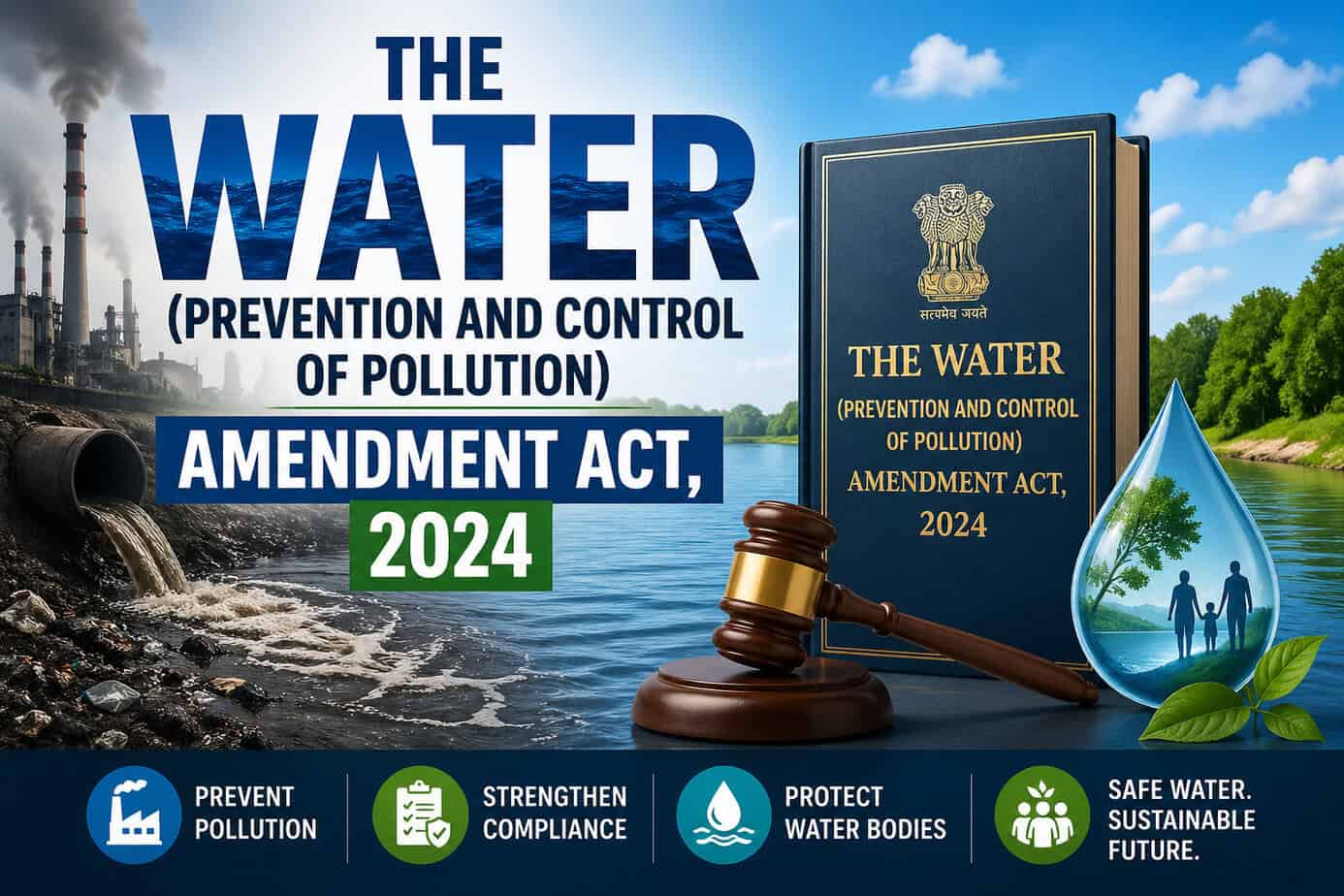
It was introduced as a Bill in February 2024 and became the Water (Prevention and Control of Pollution) Amendment Act, 2024 after Presidential assent on 15 February 2024.
1. Introduction:
The Water (Prevention and Control of Pollution) Act, 1974 was made to:
- Prevent water pollution
- Control water pollution
- Maintain cleanliness of rivers, lakes, wells etc.
- Create boards:
- CPCB = Central Pollution Control Board
- SPCB = State Pollution Control Board
Why Amendment in 2024?
Government felt:
- Some punishments were too harsh for small mistakes.
- Even minor procedural mistakes could lead to jail.
- So amendment was brought to decriminalise minor offences.
NOTE:
“Punish less by jail, regulate more by penalties.”
2. Objective of Act:
Main aims:
(a) Prevention of Water Pollution
To stop pollution before it happens.
Example:
Factory should treat waste before releasing it.
(b) Control of Water Pollution
If pollution happens, control and reduce it.
Example:
Stop toxic discharge into rivers.
(c) Maintain or Restore Water Quality
Keep rivers, lakes, ponds safe.
Example:
Prevent river becoming unsafe for drinking
(D) To replace punishment like jail for small mistakes with monetary fines.
3.Major Features of Water Amendment Act 2024
I. DECRIMINALISATION OF OFFENCES
Decriminalisation = removing jail punishment for certain minor offences and replacing with penalties/fines.
Example:
Earlier:
Offender could face:
- Imprisonment
- Fine
- Both
A small factory forgot renewal of pollution consent.Could face imprisonment.
Now:
- Mostly monetary penalty.
Range:₹10,000 to ₹15 lakh (depending on violation).
Why government did this?
Because every violation is not equally serious.
Difference:
Serious Pollution:
Should be dealt strictly.
Technical Lapse:
Can be handled by penalty.
II. ADJUDICATING OFFICERS
Government appoints Adjudicating Officers,who are usually senior officers.
Powers:
They can:
- Investigate
- Hear parties
- Determine violation
- Impose penalties
Factors they may consider:
While deciding penalty:
- Damage caused
- Repeated violation
- Economic gain from offence
- Nature of pollution
Example:
Chemical unit polluted canal.
Officer may ask:
- How much damage?
- Was it repeated?
- Did company profit?
Then penalty fixed.
III. APPEAL TO NATIONAL GREEN TRIBUNAL
Person can appeal to National Green Tribunal.
Why important?
- Provides judicial review.
- So officer not final authority.
Example:
Penalty = ₹12 lakh
Industry says unfair.
Can appeal before NGT.
IV. CONSENT SYSTEM REFORMS
The Water Amendment Act, 2024 made the consent system easier and faster. Earlier, industries had to go through a long and difficult process to get permission from Pollution Control Boards. The new reforms try to reduce delays and paperwork. Some industries that cause very little pollution may not need consent. For example, a small unit with no harmful waste may get exemption, while a chemical factory will still need permission.
The Act also provides clear rules for giving or cancelling consent. For example, if an industry follows pollution rules, it may get approval quickly. If it breaks the rules, its consent can be cancelled. These reforms make the system simple and efficient while still protecting water from pollution.
Amendment allows exemptions
Some categories may get exemptions.
Especially:
Low-risk categories.
Example:
Small non-polluting unit may get relaxation.
But hazardous unit won’t.
Purpose:
Reduce unnecessary compliance burden.
V. CENTRAL GUIDELINES FOR CONSENT
The Central Government can make guidelines for how consent should be given by State Pollution Control Boards. These guidelines help make the process simple and same in all states. They can set rules for giving consent, refusing consent, or cancelling consent. They can also fix time limits so industries do not face long delays.
For example, the government can decide in how many days a consent application should be approved and how long the consent will remain valid. If an industry follows pollution control rules, it can get consent easily. If it breaks the rules, its consent may be cancelled. In simple words, these guidelines make the consent process clear, quick, and fair while protecting water from pollution.
Purpose:
Earlier:
Different states different standards.
Now:
Consistency.
VI. CHANGES IN STATE POLLUTION CONTROL BOARDS
Some changes were made in the State Pollution Control Boards (SPCBs) to improve their working. One important change is that the Central Government can now prescribe the manner of appointment of the Chairman of the State Pollution Control Boards and also decide the terms and conditions of service. Earlier, these matters were mainly decided by the State Government.
Aim:Professionalize boards.
Why important?
- Better expertise.
Earlier criticism:Sometimes appointments political.
Now:
Technical focus intended.
VII. LIABILITY OF GOVERNMENT DEPARTMENTS
Government departments can also be held responsible if they violate pollution control rules. Under amended Section 48, if a government department causes pollution or breaks the law, the Head of the Department can be made liable and may have to pay a penalty equal to one month’s basic salary. If the fault is due to negligence of another officer, that officer can also be made liable.
Example:
For example, if a government department releases polluted water into a river and does not follow pollution rules, action can be taken against the responsible officials. However, if an officer proves that the violation happened without their knowledge and they took proper care, they may avoid liability.
4.Latest Amendments
2024 Amendment Act passed
- Bill has become Amendment Act, 2024 (not just bill now).
2026 Update
Government amended Uniform Consent Guidelines under Air and Water laws to:
- reduce delays
- streamline approvals
- strengthen compliance.
5.Conclusion
The Water Amendment Act 2024 tries to shift from criminal punishment to regulatory compliance, while retaining pollution control objectives. It attempts to balance:
- Environment protection
- Administrative efficiency
- Ease of doing business
It improves the consent system, introduces clear guidelines, brings changes in Pollution Control Boards, and makes both industries and government departments responsible for following pollution rules. The Act tries to reduce delays and unnecessary punishments while still protecting water resources.