Authored By: Neha, University Institute of Legal Studies, Panjab University, Chandigarh, Research Writer at Law Audience®,
Edited By: Mr. Varun Kumar, Advocate, Himachal, Punjab & Haryana and Founder at Law Audience.
Introduction
It is radical but also absurd to have to say by the highest court in the land that people have the right to walk on a footpath.
However, that is indeed what the Indian Supreme Court did in its iconic judgment of June 19, 2026.
Every landmark judgment begins; it seems, not with a wide public interest petition but a little incident of loss: the child was on his way to school with his father, he was only five. A tanker came from behind and hit the boy. He died. Crucially, there were no footpaths or crosswalks where the accident happened. After years of legal battles and unfair court rulings by the Motor Accident Claims Tribunal and the High Court which inexplicably reduced the compensation awarded to the grieving father, the Supreme Court stepped in.
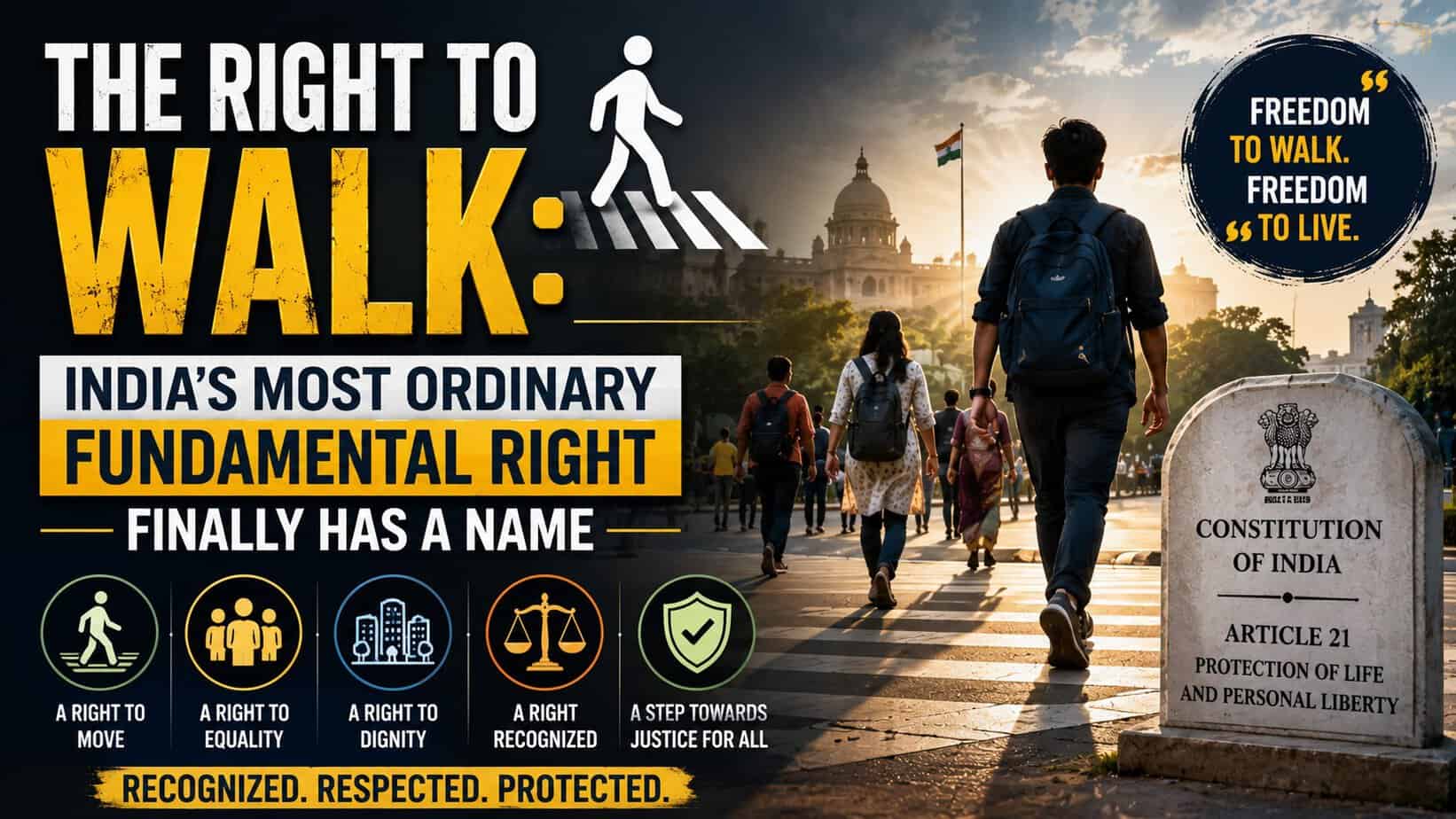
More than just fixing the legal error; Supreme Court made a historic constitutional declaration that every Indian citizen has a fundamental right to walk on a demarcated footpath.
What the Court Actually Said
The bench – Justices P.S. Narasimha and Atul S. Chandurkar, held that the right to walk is a fundamental right under Part III of the Constitution, integral to Article 19(1)(d) (the right to move freely throughout India) and Article 21 (the right to life and personal liberty). The court further connected it with Article 19 (a), (b), (c) i.e., freedom of speech, assembly, and association which implicates that one cannot meaningfully exercise any of these rights if he cannot move safely from one place to another.
Crucially, the court declared that the right to walk on footpath will have priority over the movement of vehicles on defined paths: Pedestrians first-Vehicles second.
The judgment also enforced duty on development authorities, municipalities and even panchayats to construct, demarcate and maintain footpaths. It also provides people a new way to seek justice: if someone’s right has been violated, he can now pursue constitutional and civil remedies against these authorities, irrespective of what is available under the Motor Vehicles Act, as the Act mostly focused on compensation claims for deaths rather than treating deaths as constitutional violations requiring structural accountability.
A Number Worth Sitting With
Instead of discussing complex legal theories or constitutional philosophies, look at the 2024 statistics: 25,769 pedestrians were killed in road accidents in India. That isn’t bad luck; it is a systematic outcome of an environment that treated the person on foot as an afterthought.
India accounts for 11% global road accident deaths despite having only 1% of world’s vehicles. This is a national disgrace. Most of this happens because of the absence of safe infrastructures for pedestrians, such as missing footpaths, missing pedestrian crossings, and roads designed without any thought given for people who do not own any vehicle.
According to the data given by the Centre for Science and Environment, 649 pedestrians died in Delhi in 2025, with pedestrians accounting for 43% of all road deaths in the city- which means one in every two people dying in road accidents is a pedestrian. In Bihar and West Bengal, the situation is even worse, as pedestrians account for more than half of all road accident deaths. They are not just traffic accidents. They are predictable consequences of poor planning of cities designed for speed of vehicles rather than safety of women, elders, workers and children.
The Rights That Were Already There — Just Never Named
From a constitutional perspective, the Court did not create a new right. Instead, it declared a right that was always there but had never been explicitly stated.
Article 19(1)(d) gives every Indian citizen the right to move freely across the territory. The Supreme Court’s reasoning is simple: the most basic way to move is by walking. Before the right to travel by car, train, or plane, you must first have the right to walk on your own feet. This fundamental right to walk comes before the right to use vehicles.
When combined with Article 21—the right to life—the right to walk safely becomes even stronger. The Court has long defined the ‘right to life’ as more than just staying alive; it includes living with dignity, health, and a clean environment. Therefore, it makes sense that a life where you cannot leave your house without risking death from traffic is not a life protected by the Constitution.
The Way Forward (And Why Scepticism Is Warranted)
The court did more than just a declaration. It directed that its judgment be sent to the Ministries of Housing and Urban Affairs, Rural Development, and Road Transport and Highways, as well as the Law Commission of India, with a view to developing a comprehensive statutory framework. It also converted the case into a petition under Article 32, titled “Re: Fundamental Right to Walk and Footpath”, ensuring continuous monitoring rather than just dropping the matter after a single verdict. These are important steps as if a new legislation or enforceable remedies are created, it could be truly transformative.
However, anyone who has tried to walk on a footpath in an Indian city is naturally sceptive as there is a big gap between courts’ declaration and ground reality. Right after the judgment, the authorities in Delhi began clearing footpaths which is good but an old pattern i.e., quick action after a public moment of accountability, followed by things going back to normal. Eventually, street vendors return, motorbikes park on the sidewalks again, and potholes remain unfilled.
The issue is into the system, not merely people’s behavior. Indian cities have been historically designed for cars. Projects to widen roads often take away space meant for walking. Utility companies dig up sidewalks and fail to fix them. Street vendors, who are just trying to earn a living, end up using the only walking space left. There is no single person to blame. The problem is a system that has never prioritized pedestrian safety.
Now, the Supreme Court has ordered that safety must be a top priority. It is a constitutional command. The real test is whether the government will actually follow this command.
Conclusion
The main point is: this is not just about footpaths. It is about for whom cities are built for.
For a long time, most Indian cities were designed for people who can afford to drive through it. This has pushed walkers- mostly the poor, the young, the elderly, the disabled, and women, to the sidelines. Broken and blocked footpaths send a daily message to these people that their safety and movement do not matter.
The Supreme Court has now declared this as unconstitutional. They stated that a person on foot has a more important right than a driver in an SUV or a delivery truck.
A decade after a young boy died because a road lacked a footpath, the Court declared that every road must have one. This is a fundamental right. It always was. Now, it is officially recognized.
Refrences
- Fundamental Right to Walk – Supreme Court Observer
- Right To Walk A Fundamental Right; Authorities Have Duty To Demarcate Footpaths : Supreme Court
- Law Needed To Protect Right To Walk On Footpaths : Supreme Court Tells Centre
- Supreme Court of India rules right to walk on footpaths is a fundamental right | The Business Standard
- From a child’s tragic death to a landmark verdict: SC declares Right to Walk a Fundamental Right – The Jharkhand Story
- Maniyar Iliyaz @ Shaik Riyaz and Another v. P. Ayyappan and Others – Supreme Court Cases
- Power To The Foot – India Legal