Authored By: Neha, University Institute of Legal Studies, Panjab University, Chandigarh, Research Writer at Law Audience®,
Edited By: Mr. Varun Kumar, Advocate, Himachal, Punjab & Haryana and Founder at Law Audience.
Introduction: A Charged Floor, A Quiet Bill:
On April 16, 2026, the Lok Sabha was in middle of its most important and special sessions of the year. The slogans were loud and opposition has demanded a division of votes, forcing every member to put their stance on record. The electronic vote showed 251 in favor and 185 against. India’s political boundaries were about to change as three new laws had just been proposed: (i) the Constitution (131st Amendment) Bill, 2026; (ii) the Union Territories Laws (Amendment) Bill, 2026; and (iii) the Delimitation Bill, 2026.
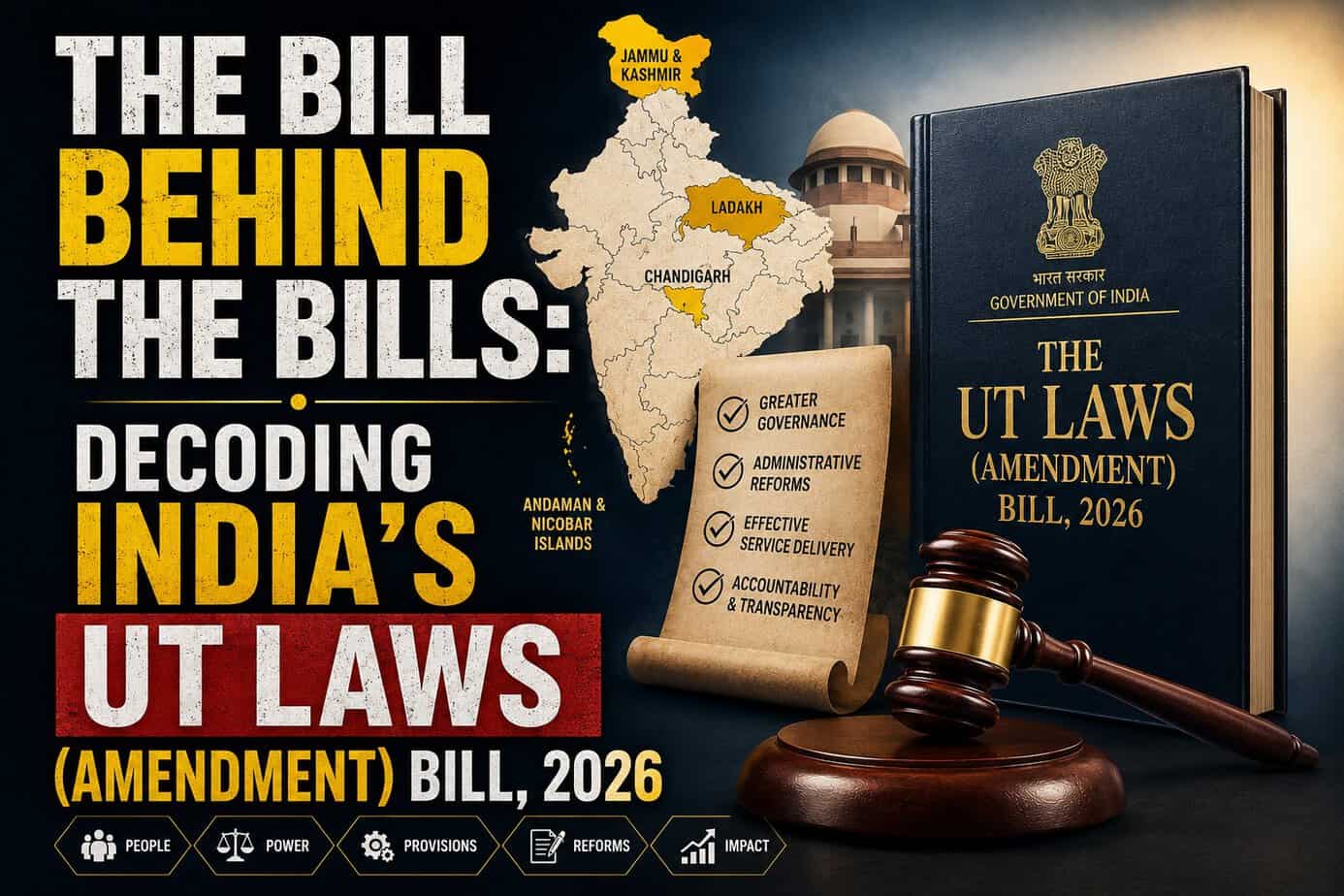
Most news coverage focused on the new Constitution (131st Amendment) Bill, which aims to increase the number of Lok Sabha seats from 550 to 850 and reserve seats for women. However, Home Minister Mr. Amit Shah also introduced a less discussed but equally important law: the Union Territories Laws (Amendment) Bill, 2026.
The Problem This Bill Solves:
To understand this Bill, we have to look back three years. In September 2023, Parliament passed a law to reserve one-third of seats for women in the Lok Sabha and State Assemblies. Everyone celebrated this historic move, but there was a problem. The law stated that this reservation would only start after the next census and delimitation. Since India’s census is already very late, women might have had to wait until the mid-2030s.
To fix this, the 2026 Bills suggest using the 2011 census data instead of waiting for a new one. However, there was still one issue: while the state laws changed, Union Territories like Delhi and Jammu & Kashmir followed different rules that did not include women’s reservation. The UT Laws (Amendment) Bill, 2026 was created specifically to fix this gap.
What the Bill Actually Does:
In plain terms, the Bill amends three existing laws:
- Government of Union Territories Act, 1963 (which governs Puducherry)
- Government of National Capital Territory of Delhi Act, 1991
- Jammu and Kashmir Re-organization Act, 2019
The changes can be grouped into three main parts:
First, Delimitation Commission is given power to redraw assembly and parliamentary constituencies within these UTs — based on the 2011 Census.
Second, instead of setting a fixed number of seats, the Bill sets a minimum. For example, instead of saying “Delhi shall have 70 seats,” the Bill says “Delhi shall have not less than 70 seats”, leaving room to increase the number.
Third, it increases the number of appointed members in the Puducherry and J&K assemblies, making sure women are included among them.
One small but important change: the law officially changes the name from ‘Pondicherry’ to ‘Puducherry,’ something the UT itself has long sought.
UT by UT: What Changes Where:
Delhi: Delhi’s Legislative Assembly currently has 70 seats, but this number is fixed by law. The new Bill allows Delimitation Commission to decide the final number of seats, ensuring there are minimum 70. As Delhi’s population has grown a lot since 2011, the number of seats could increase significantly. Also, one-third of the seats will be reserved for women, rotated across different constituencies every election.
Puducherry: Presently Puducherry has 30 Assembly seats. Like Delhi, Delimitation Commission will determine the new number of seats, but there will be minimum 30. The major change is in nominated members: the current law allows the Central Government to nominate up to 3 members to the Assembly. After delimitation, this will rise to 5 nominated members – at least 2 must be women. Also, the law will officially replace every mentions of “Pondicherry” to “Puducherry”.
Jammu & Kashmir: Currently the Jammu and Kashmir Assembly has 114 seats. Under this new Bill, the Delimitation Commission will decide the final number of seats, but there will be minimum114. On nominated members, the Lieutenant Governor currently has the power to nominate 2 members to represent women. After delimitation, this will increase to 3.
The Bigger Picture — Three Bills, One Mission:
The UT Laws (Amendment) Bill is one leg of a three-piece legislative package that together reshapes India’s electoral architecture:
The Constitution (131st Amendment) Bill amends the Constitution to allow delimitation based on the 2011 Census. It removes the freeze on seat allocation based on 2011 Census, and increases maximum size of Lok Sabha from 550 to 850. Because it amends the Constitution, it requires a two-thirds majority in both Houses.
Second, the Delimitation Bill, 2026 sets up the actual machinery, called the Delimitation Commission, which will redraw the constituencies and allocate seats reserved for women.
The UT Laws (Amendment) Bill connects everything. It makes sure that changes made to States also apply to Delhi, Puducherry, and J&K. This bill is easy to pass because it only needs a simple majority.
However, the problem is: if the 131st Constitutional Amendment fails, this UT Bill becomes mostly useless. On April 17, 2026, the Constitutional Amendment failed because it did not get the required two-thirds majority, receiving 298 votes for and 230 against. Now, the future of all these laws is uncertain.
The Political Battle:
The introduction of these Bills was difficult. The Opposition demanded a formal vote, forcing every MP to put their stance on record. The Bills passed with 251 Ayes and 185 Noes, but the conflict continued.
During the debate, 130 members spoke, including 56 women, and the arguments were intense. The Opposition claimed the government was just delaying women’s reservation by linking it to new census data and delimitation. They argued this could push the law to 2029 or later. They also noted that no OBC sub-quota exists within the women’s reservation, meaning upper-caste women would benefit the most. Home Minister Mr. Amit Shah disagreed. He argued that the Opposition was actually against the reservation itself. He invoked the Constituent Assembly’s principle of “one person, one vote, one value” and argued that using the 2011 Census was a practical and constitutionally sound approach to avoid indefinite delay. The next day, the amendment failed to get two-thirds majority. The political battle is far from resolved.
The Real Controversies:
Beyond the political aspect, there are some real issues which require honest scrutiny:
The Shift in Power from South to North: switching from 1971 to 2011 census will lead to a drastic effect on state-wise seat distribution in Parliament. Tamil Nadu could drop from 39 to 32 seats; Kerala could go from 20 to 15 seats. Highly populated states like Uttar Pradesh and Bihar would gain many seats. This will panelize southern states for successfully controlling population growth. Why should good governance costs political power?
Parliament Controlling Boundary Changes: previously, the law required delimitation after every census. After the 131st Amendment, Parliament can decide when to carry delimitation and which census to use. This gives the party in power huge control over how electoral boundaries are set up.
The Imbalance between the Two Houses: Increasing the Lok Sabha to 850 seats while keeping the Rajya Sabha at 250 changes the balance of power. This means the Lok Sabha will have much more influence during joint sittings, and the Rajya Sabha will have less say in election of the President and Vice-President.
The OBC Reservation Issue: The plan to reserve one-third of seats for women does not include provisions for OBC women. Since OBC communities make up a large part of the population, leaving them out is a major social and political gap.
Way Forward:
The 131st Constitutional Amendment failed once, but it can still succeed. The government can try again with more support, negotiate with regional parties about the OBC issue, or wait for the 2027 census data.
Regarding the UT Laws Bill, the government could pass it as an ordinary legislation, but it would lack strong legal support without the main amendment. For the 2029 general elections, the clock is ticking. If the government wants to implement delimitation and women’s reservation by then, the amendment needs to pass soon. This process involves many steps, like electing a new Parliament and setting up new constituencies.
Meanwhile, southern political parties- DMK, TRS successors, etc., will likely refuse to support any bill that costs their number of seats without significant concessions. Future negotiations will involve both women’s rights and power-sharing between the central and state governments.
Conclusion:
It is easy to focus only on the statistics, such as seat counts and census numbers. However, every constituency represents real voters. Every reserved seat represents a woman who might finally get a real chance to represent and lead her constituency in a legislature. For a woman councilor in Puducherry waiting years for a chance, or an aspiring politician in J&K facing new rules, this Bill is not just a concept. It is the difference between the system opening a door or keeping it shut.
Indian democracy is always evolving through debate and disagreement. The UT Laws (Amendment) Bill, 2026 is part of this ongoing journey. Whether it passes as is or is changed later, the debate it started about fair representation and voting rights is a conversation India needs to have.
References:
- Union_Territories_Laws(A)_Bill_2026.pdf
- Lok Sabha Rejects Constitution (131st) Bill 2026 On Delimitation
- Union Territories Laws (Amendment) Bill, 2026 | SCC Times
Union Territories Laws (Amendment) Bill, 2026: What it means for Assembly size – CNBC TV18