
Authored By: Kimaya Joshi (B.B.A.LL.B (Hons)), NMIMS Hyderabad, Research Writer at Law Audience,
Edited By: Mr. Varun Kumar, Advocate, Himachal, Punjab & Haryana and Founder at Law Audience
A trademark is “Any sign, or any combination of signs, capable of distinguishing the goods or services of one undertaking from those of other undertakings, shall be capable of constituting a trademark. Such signs, in particular words including personal names, letters, numerals, figurative elements and combinations of colours as well as any combination of such signs” as per Article 15 of the TRIPS Agreement.[1]
In the Trademarks Act,1999, a Trademark as per section 2(1)(zb) is defined as “a mark capable of being represented graphically and which is capable of distinguishing the goods or services of one person from those of others and may include shape of goods, their packaging and combination of colours.”[2] Hence under the Indian law, such a mark qualifies as a trademark.
Non-Conventional Trademarks
Trademark acts as a source identifier. And commonly these marks are in form of words or logos including personal names, numerical, letters and combination of colours. There are however, certain distinct marks which are considered trademarks but do not fit in the standard categories like words and logos. These marks are called as non-conventional trademarks. Hence, this category of marks is not about what is included, its about what is excluded from the conventional category of trademarks. The non-conventional trademarks can be broadly categorized into two categories, visual marks such as trade dress, holographic mark, motion mark, colour marks, and non-visual marks such as sound mark, olfactory mark, texture mark, taste mark. The unconventionality of the mark, however, does not award it any rights beyond that of a traditional trademark.[3]
Olfactory Trademark
Olfactory or smell marks are one of the types non-conventional marks. These marks pose specific problems due to their inability to be represented graphically. There are also concerns regarding their durability and distinctiveness. Some countries like the United States, the United Kingdom, Australia, etc, do accept Olfactory Trademarks provided that, they use distinctive and non-functional scent for their products.
Olfactory Trademark in India
The legal regime in India is centred around marks that can be graphically represented and are distinctive fulfilling the function of distinguishing goods and services of one from another. Recently in 2025, the Controller General of Patents, Designs and Trade Marks (‘CGPDTM’) approved Sumitomo Rubber Industries Ltd.’s application for “Floral fragrance / Smell reminiscent of Roses as applied to Tyres” (Class 12: tyres for vehicles) on a proposed-to-be-used basis.[4] This marked as India’s first olfactory mark opening a scope for Non-Conventional Trademarks to flourish in India.
The Sumitomo Rubber Industries Case
Sumitomo’s rose-scented tyres were the first smell mark ever registered in the UK, granted in 1996 and it stands relevant to this day.[5] On 23rd March 2023, Sumitomo Rubber Industries Ltd filed an application for the mark “FLORAL FRAGRANCE / SMELL REMINISCENT OF ROSES AS APPLIED TO TYRES,” claimed in Class 12 (vehicles) on a proposed-to-be-used basis. Due to the lack of smell mark category in the registry’s e-filling system, the company proceeded under a conventional category (the registry has since recorded it as a device mark), with the description and supporting materials clarifying that the true claim was olfactory.[6]
The First Examination Report of 4rth August 2023 contained two objections. The grounds were the lack of graphical representation and lack of distinctiveness. Since the issues were novel, a senior IP counsel Pravin Anand of Anand and Anand was appointed by the Registry as amicus curiae, an independent advisor to the Registry. In response, the company presented a scientific graphical representation that is, the IIIT Allahabad Vector Model also known as the 7-dimensional vector representation of the scent.
Using an established model of olfaction, researchers from the Indian Institute of Information Technology, Allahabad, plotted the composite “rose-like” odour onto seven axes (floral, fruity, woody, nutty, pungent, sweet, minty)[7] and each descriptor was assigned an intensity value, plotted on a radar graph. Hey explained that aroma from rose arises from a complex mixture of volatile compounds interacting with human olfactory receptors. This scientific scheme captured the intangible aroma and gave it a form that acts as graphical representation of the same.
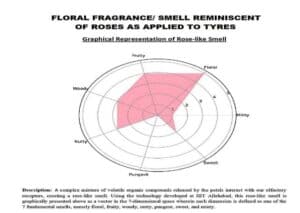
Source: Annexure A of order of the Trade Mark Registry dated November 21, 2025.
Sumitomo also presented Gas chromatography and mass spectrometry on record that identified that molecular fingerprint of the rose fragrance and the Olfactory specialists by filing sworn statements attested that the fragrance acted as a brand identifier and not a performance feature added for function ability.[8]
The Registrar on 21st November 2025, accepted the application and held that the trademark satisfies the criteria laid down for registration under the Trade Marks Act, 1999, as it is clear, precise, self-contained, intelligible, objective and is represented graphically. It also directed the Registry “to advertise the trade mark application bearing No. 5860303 for “FLORAL FRAGRANCE / SMELL REMINISCENT OF ROSES AS APPLIED TO TYRES” in class 12 on a “proposed to be used basis” in accordance with the 12 provisions of section 20 of the Trade Marks Act, 1999 as an ‘olfactory mark’ along with the following graphical representation and description submitted by the Applicant.”[9][10]
[1] WTO | Intellectual Property (TRIPS) – Agreement Text – Standards, https://www.wto.org/english/docs_e/legal_e/31bis_trips_04_e.htm#2 (last visited June 27, 2026).
[2] Section 2(1)(z) in The Trade Marks Act, 1999, https://indiankanoon.org/doc/137500283/ (last visited June 27, 2026).
[3] Diganth Raj Sehgal, Non-Conventional Trademarks and the Procedural Requirements for Their Registration, iPleaders (Apr. 27, 2021), https://blog.ipleaders.in/non-conventional-trademarks-procedural-requirements-registration/.
[4] Harsh Gour, Decoding India’s First Accepted Smell Trademark: ‘Rose-Fragranced Tyres,’ The Leaflet (Nov. 27, 2025), https://theleaflet.in/digital-rights/law-and-technology/decoding-indias-first-accepted-smell-trademark-rose-fragranced-tyres.
[5] Scenting the Future: How India’s First Smell Mark Application Aligns with Global Jurisprudence | IP STARS, asialaw, https://www.asialaw.com/NewsAndAnalysis/scenting-the-future-how-indias-first-smell-mark-application-aligns-with-global/Index/2475 (last visited June 27, 2026).
[6] Smell Trademarks: The New Rage in Trademarks, Intepat (Apr. 22, 2026), https://www.intepat.com/blog/smell-trademarks-india.
[7] Gour, supra note 4.
[8] Smell Trademarks, supra note 6.
[9] India’s Trademark Registry Accepts Its First Smell Trademark For Japanese Company’s Rose-Scented Tyres, https://www.livelaw.in/ipr/india-first-smell-trademark-sumitomo-rubber-rose-fragrance-tyres-310803 (last visited June 27, 2026).
[10] Editor, CAM Acts as Indian Legal Counsel to Sumitomo Rubber in India’s First Accepted Olfactory Mark, SCC Times (Nov. 24, 2025), https://www.scconline.com/blog/post/2025/11/24/cam-advises-sumitomo-rubber-first-smell-mark-india-2025/.