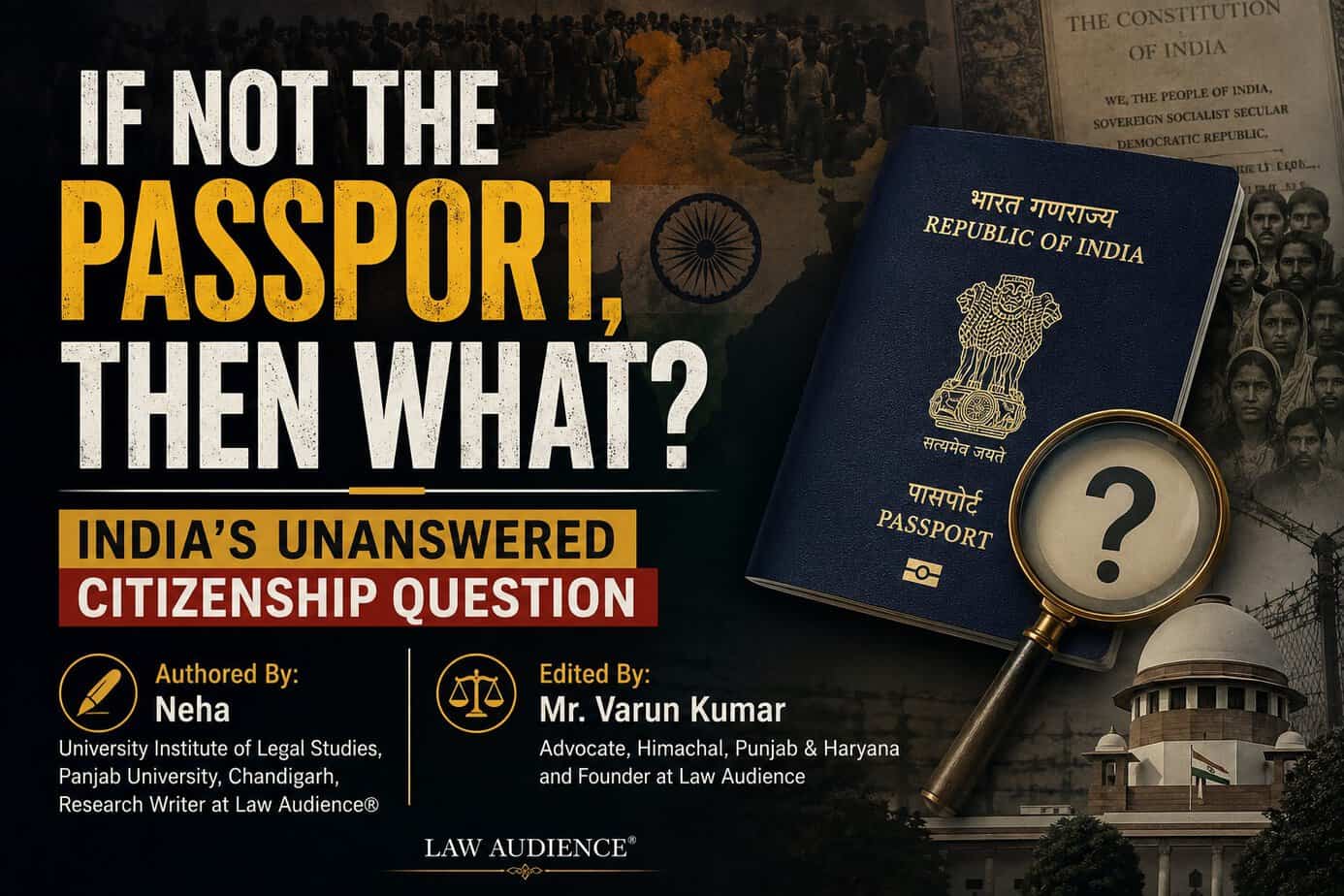
Authored By: Neha, University Institute of Legal Studies, Panjab University, Chandigarh, Research Writer at Law Audience®,
Edited By: Mr. Varun Kumar, Advocate, Himachal, Punjab & Haryana and Founder at Law Audience.
Introduction
If someone asked you to prove your Indian citizenship, what document would you use? Most people would grab their passport or Aadhaar card. However, legally, neither of these conclusively proves your citizenship.
It took a single question from a journalist to expose a gap that the Indian citizenship is carrying for decades. While answering a query from The Hindu on whether an Indian passport could be used to challenge exclusion from voter rolls during the ongoing Special Intensive Revision (SIR) of electoral rolls, an official from Ministry of External Affairs clarified that passport is a travel document, not a citizenship document. He explained that a passport shows nationality while travelling; it is not legally a citizenship document. Although the statement is doctrinally correct, it raises an urgent question: if not the passport, what actually proves that someone is an Indian Citizen?
A Distinction That’s Existed All Along
Even though the Ministry of External Affairs’ (MEA) explanation caused a political shockwave, it doesn’t change any existing legal grounds. The government’s own passport manual has always said that while a passport is evidence of nationality, it is not conclusive proof. In cases where a person’s citizenship is questioned, courts can look at other evidence as well.
This seems to conflict with a 1978 Supreme Court ruling in Maneka Gandhi v. Union of India, under which issuance of passport itself proceeds on the basis of conclusive proof of Indian nationality. However, the statutory law resolves this contradiction. Section 6(2)(a) of the Passports Act, 1967 allows authorities to refuse passports to non-citizens, but Section 20 empowers the government to issue them to non-citizens if it is in the public interest. This small exception means a passport cannot be seen as absolute proof of citizenship in every single case.
Essentially, the MEA is making a technical distinction: a passport is strong evidence of citizenship, but it is not the final conclusive legal proof. Final proof must be determined under the Citizenship Act, 1955, not the Passports Act, 1967.
Aadhaar Is for Identity, Not Nationality
If a passport is not conclusive proof of identity, Aadhaar is even lesser. Since it is introduced about fifteen years ago, the UIDAI has always maintained that Aadhaar establishes identity and address, but not citizenship. In fact, legal residents who are not citizens can also have Aadhaar. The Supreme Court recently held this in May 2026 judgment upholding the constitutional validity of the SIR, that while Aadhaar can be admissible as identity, it does not prove citizenship.
Do Voter IDs and Electoral Rolls Count?
Not definitively, and the law also has changed significantly. In Lal Babu Hussein v. Electoral Registration Officer (1995), the Supreme Court held that the voters whose name appears on the voter list or electoral roll are presumed to be citizens unless proves otherwise. However, in the 2026 SIR judgment, the Court set a sharp boundary: the Election Commission can only determine the eligibility for the electoral roll, not a person’s citizenship. This means a person does not automatically lose their citizenship just because they are removed from the electoral roll.
This difference matters in real world. The Election Commission listed the passport as one of eleven documents used to indicate citizenship. In Uttar Pradesh, some voters who were wrongly removed from the lists used their passports to get back on them. However, this hasn’t worked everywhere. In West Bengal, some people with Indian passports were still removed from the draft electoral rolls. Because the rules are applied inconsistently, the Ministry of External Affairs’ recent statement feels less like a minor update and more like a real threat to people’s rights.
So, How Do You Actually Prove Indian Citizenship?
The legal rules here are very unclear. In August 2025, the Minister of State for Home, Nityanand Rai, while responding to a question in Lok Sabha did not specify any list or categories of documents for proving citizenship. He only said that citizenship is governed by the Citizenship Act of 1955. According to this law, citizenship can be acquired by birth, descent, registration, naturalization, or incorporation of territory.
Only two categories of people have conclusive proof: those with citizenship certificates (issued to those who acquire citizenship by registration or naturalization). However, most Indians are citizens by birth or descent and do not have these certificates. For them, citizenship must be proven using indirect evidence, and the evidence changes based on their birth year:
- Born between January 26, 1950 and July 1, 1987: citizenship follows automatically from birth in India, regardless of parents’ nationality. But since birth certificates were not mandatory in this period, many rely on alternative records, including educational certificates and Aadhaar.
- Born between July 1, 1987 and December 3, 2004: proof of one’s own birth is no longer enough; at least one parent must also be shown to have been an Indian citizen at the time.
- Born on or after December 3, 2004: requires one citizen parent, with the other parent additionally required not to be an illegal migrant, a considerably harder evidentiary bar.
The Structural Problem Nobody Has Fixed
India does not have one single document that proves universal citizenship. A major attempt to create one, called the National Register of Citizens, caused huge political problems. This happened because nationwide verification risked excluding people who simply lacked paperwork. Former Foreign Secretary Nirupama Rao suggests a better solution: instead of making new ID cards, the government should focus on improving civil registration. By making birth registration and record-keeping stronger and more reliable, people won’t lose their citizenship just because of missing or messy paperwork.
Conclusion
The Ministry of External Affairs’ clarification is not remarkable, but it is important for administration because it comes at a time when the SIR exercise is actually removing people from voter lists. When there’s no clear document to prove citizenship, the cost isn’t just confusion; it can be losing your right to vote. India’s citizenship rules were never built around one solid, reliable document. Instead, they depend on a mix of records that were designed for other purposes. Until the government focuses on building strong, consistent birth and civil registration records, ordinary citizens will keep facing the same problem: discovering, often at the worst possible time, that nothing in their wallet is enough to legally prove who they are.
References
- Lia, Rizmi M., and Jebaraj, Priscilla. “Which document proves Indian citizenship?” The Hindu (Mumbai), 28 June 2026.
- Maneka Gandhi vs Union Of India on 25 January, 1978
- Lal Babu Hussein & Others vs Electrol Registration Officer & Others on 6 February, 1995
- THE PASSPORTS ACT, 1967
- SC upholds SIR, says it is in consonance with Representation of the People Act: highlights – The Hindu
- Not passport, Aadhaar or voter ID: Which document actually proves you are an Indian citizen? FAQs answered | India News – The Times of India