Click here to download the full paper (PDF)
Authored By: Aditi Choudhary (B.A.LL.B), Law College Dehradun),
Click here for Copyright Policy.
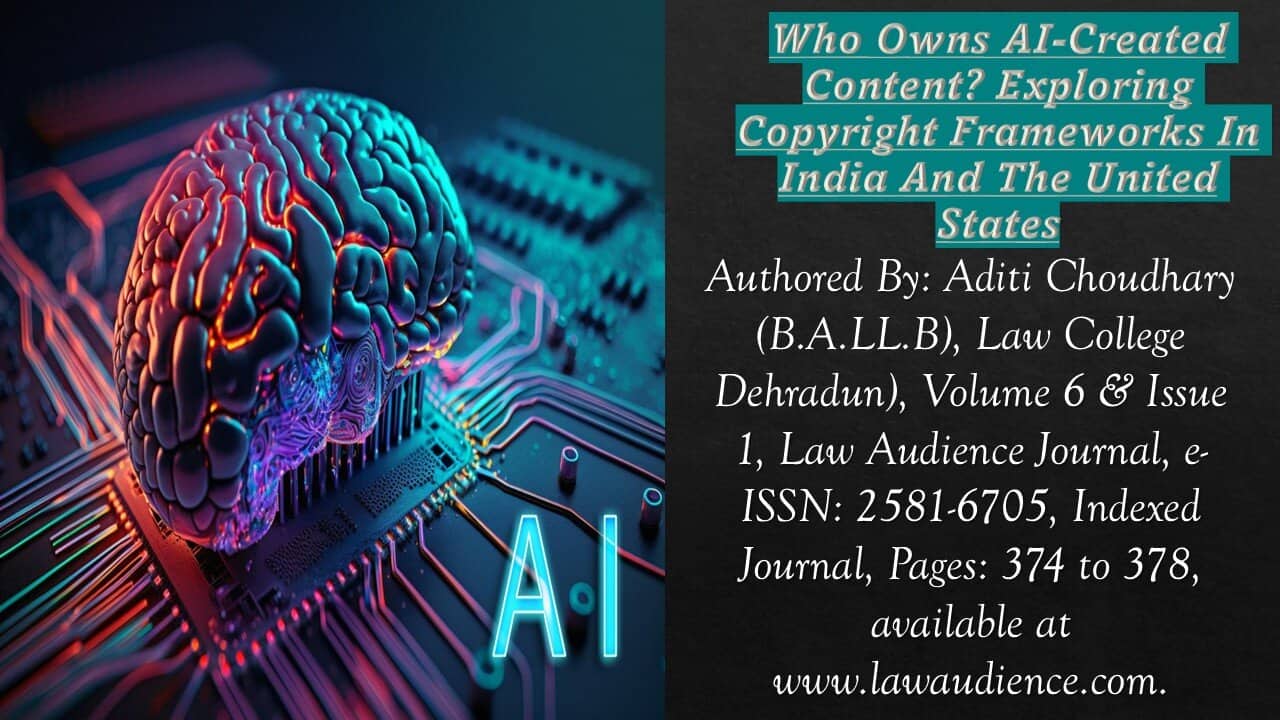
“WHO OWNS AI-CREATED CONTENT? EXPLORING COPYRIGHT FRAMEWORKS IN INDIA AND THE UNITED STATES”
In recent years, Artificial Intelligence (AI), has moved beyond its traditional role as background technology to become a prominent creator across a wide range of industries. In the present day, anyone can generate stories, songs, sketches or poems in no time using sites like ChatGPT, Midjourney and DALL.E. A few months ago, just for fun, I asked ChatGPT to write a short poem for Mother’s Day. Within seconds, it gave me a sweet, heartfelt piece, something I could’ve easily shared on a card or posted online. I was genuinely impressed, but also a little unsure. I had not written a single word of it myself, yet it felt personal. That made me stop and
think: who actually owns something like this? Me, the person who typed the prompt. Or the AI that created it? Although these platforms have transformed the way we create and made content creation more accessible, they have also put age old legal concepts to test – especially in Intellectual property law (IP Law). Who is the owner of all the works created by AI? Who owns the right to it? Traditionally in our countries (India as well as in the USA), our copyright
Laws are there to protect work created by humans and not an output given by a machine. As AI content is becoming more established and common; technological and legal clarity is growing apart. This article delves into how IP Laws are or are not accepting or adapting the growth of AI as something that creates content and what this means for future copyright. Copyright law is quite similar in India and USA, in a way that, they are both based on the principle of human authorship. India has Copyright Act, 1957 of which Section 2(d) defines who qualifies as an “author”, and this definition is central to determining copyright ownership. While the law outlines distinct categories depending on the type of creative work, clause (vi) specifically addresses computer-generated content. It states that in such cases, the author is considered to be “the person who causes the work to be created.” This language, however, was drafted long before generative AI existed in its current form. It was intended for situations where a person used a computer as a tool, such as typing a document or designing artwork using software. With AI platforms like ChatGPT or Midjourney, where the final output is generated automatically based on a simple prompt, it’s unclear whether the user’s involvement is active or creative enough to be considered as “causing” the work. This ambiguity makes it difficult to apply existing copyright definitions to AI-generated content, leaving creators, developers, and users without clear legal guidance. Likewise, in the United States, the Copyright Office has made it clear that copyright protection would only apply to work that are the product of human creativity. The policies were updated in the year 2023 and 2024, and the office rejected copyright claims for any images or texts that were created by AI on its own, upholding that machines cannot hold or transfer any creative rights. The more people who are using AI to create content for either commercial or public use the more this legal viewpoint is becoming more crucial. If a work cannot be copyrighted, it also cannot be legally owned, protected, or monetized in the usual way. One of the well-known cases is of the Jason Allen from the year 2022, where he created an artwork “Théâtre D’opéra Spatial” using Midjourney, it won him a prize at the Colorado State Fair. Even though the work wasn’t removed from consideration, it prompted a discussion on this pervasive controversy and sparked a debate ver whether an AI-assisted work should qualify for recognition or copyright, underlining just how unprepared current laws are for this new creative frontier.[1] When we talk about any content that is created by AI , the most important question that comes to our mind is that if the one who is typing the prompt can claim to be the author. Some scholars propose that forming the right prompt also requires creativity and skill. It’s worth noting that Florida Law Review describes “prompt engineering” as new way of expression, where users iterate and polish inputs until the outcome aligns with their plan[2]. However, this view was completely rejected by the legal authorities. The Copyright Office of US, did not accept an application for copyright protection for Jason Allen’s Midjourney created work that was also the champion of the Colorado State Fair of the year 2022, because Midjourney contributed “more than a de minimis amount” to the end product i.e the piece created, even though Allen used 624 prompts and made refinements later . That decision was later supported by the Copyright Review Board and is now being appealed[3]. Further, the U.S. Court of Appeals for the D.C. Circuit has affirmed that a person must create a work to claim copyright, dismissing attempts to treat the AI or its user as the author. So, it can be concluded that these judgements show that simply putting in a prompt, regardless of it being clever or being very polished, fails to meet the legal criteria for authorship. Prompt engineering may be extraordinarily innovative or imaginative or creative, but current law calls for control over the final expression, not just the early instruction. Therefore, the people who completely depend on AI to generate entire work face a legal ambiguity where their efforts on prompt or edits made afterward, however creative, may not qualify for legal protection under existing IP frameworks. As judiciary and lawmaking authorities continue to struggle with AI authorship, many AI platforms strive to cover the gap in law through their own terms of service. Let’s take OpenAI as an example, its current usage policy, you secure full authorship of both your initial inputs and the result generated by ChatGPT. OpenAI has even stated it “assign[s] to you all our right, title, and interest” in that piece[4]. While they give users a right to use AI created materials commercially, at least contractually, Midjourney has taken a different path by giving a non-commercial license to users that are not paying for it and giving a slight broader rights to paid members, but still all generated contents remain subjected to “perpetual, worldwide, sub-licensable, royalty-free, and irrevocable license” given back to Midjourney[5] . And then comes Adobe Firefly that has a different model, they allowed AI created pieces to be used commercially, as long as the user complies with all the requirements of license and they use non-beta, commercially safe models. Even though these sites have given some kind of contractual comfort to their users, their legal enforceability is still not very clear[6]. Critics reason that if any AI created content is not copyrightable then these sites or platforms have nothing to legally to license. Additionally, these provisions can change at any point, exposing the users to changing rights and risks. Regardless of if the site’s contract appears to provide right to ownership, Judiciary can still rule that, under law, no human owned copyright exists to transfer in the first place. This contractual patchwork leaves a very weak and unreliable framework: somehow working in current situation, but at risk of being unstable once put to test in litigation or under transitioning laws. As content created by AI is still expanding every day, expert bodies like WIPO have requested policymakers to give IP frameworks a thought again. There’s an ongoing conversation on IP and AI that specifically raises a point if AI’s creation should get new forms of legal shield and are the current incentives for human creators are still good for purpose[7]. Many scholars like Pamela Samuelson gave a model of hybrid authorship, in this model people who meaningfully guide AI through ‘prompt engineering’ receive credit, possibly together with sui generis rights to safeguard AI-created works without disrupting traditional copyright. Such changes are not only academic but they’re urgent on a global scale. With no common standards, creators and platforms may encounter mosaics of regulatory frameworks across different countries in the world, leading to obscurity and stifled innovation. Worse, prolongations in clear legal framework could incentivize unlicensed use of copyrighted works for AI training or cause rising talents and startups to be reluctant before using any AI tools. A preemptive plan can either be revising and updating copyright laws to include hybrid authorship as suggested by many scholars or accepting tailored protections for AI generated content could make sure creators are given both credit as well as should be incentivized while turning the balance toward fairness and clarity. If neither of these is followed, we are risking a creative ecosystem constrained by legal uncertainty, and a landscape where innovation outpaced oversight, and rights become outdated by the time they’re recognized. Given the rising effect of AI in creative industries, it is clearly evident that existing IP law is no longer adequate. In this paper we have explores, both Indian and U.S. copyright laws continue to be only around the idea of human authorship, leaving a minimal space for the unique characteristic of content created by AI .The way things stand today, the person using AI tools no matter how thoughtfully has a limited role under the law, and even the rules set by tech platforms are often unclear or inconsistent. All of this points to one thing: our legal system hasn’t kept pace with the speed at which AI is evolving. Unless there’s a serious effort to update how we define authorship or to introduce new rights that reflect the reality of AI generated content, both creators and users will continue to operate in legal uncertainty. AI is no longer some distant idea it’s part of our everyday creative lives. It’s time for the law to catch up and evolve with the same urgency and imagination that technology has shown.
Cite this article as:
Aditi Choudhary, “Who Owns AI-Created Content? Exploring Copyright Frameworks In India And The United States” Vol.6 & Issue 1, Law Audience Journal (e-ISSN: 2581-6705), Pages 374 to 378 (17th July 2025), available at https://www.lawaudience.com/who-owns-ai-created-content-exploring-copyright-frameworks-in-india-and-the-united-states/.
Footnotes and References:
[1] An A.I.-Generated Picture Won an Art Prize. Artists Aren’t Happy., N.Y. Times (Sept. 2, 2022), https://www.nytimes.com/2022/09/02/technology/ai-artificial-intelligence-artists.html.
[2] Mark A. Lemley, How Generative AI Turns Copyright Upside Down, 25 Sci. & Tech. L. Rev. 29 (2022).
[3] Amol Parikh, Tragic Ending: Award‑Winning AI Artwork Refused Copyright Registration, IP Update (Sept. 21, 2023), https://www.ipupdate.com/2023/09/tragic-ending-award-winning-ai-artwork-refused-copyright-registration/.
[4] Terms of Use, OpenAI, https://openai.com/policies/terms-of-use (last visited July 8, 2025).
[5] Midjourney Terms and Conditions Explained, Medium (Mar. 20, 2023), https://docs.midjourney.com/hc/en-us/articles/32083055291277-Terms-of-Service.
[6] Mark A. Lemley & Peter Henderson, The Mirage of Artificial Intelligence Terms of Use Restrictions, Princeton Univ. Program in Law & Pub. Affairs Research Paper No. 2025-04, at 10 (Jan. 10, 2025).
[7] Georgina Rigg, Deep Fakes, Inventorship and Ethics—WIPO Revised Issues Paper on Artificial Intelligence, IP Law Watch (Sept. 30, 2020).