Click here to download the full paper (PDF)
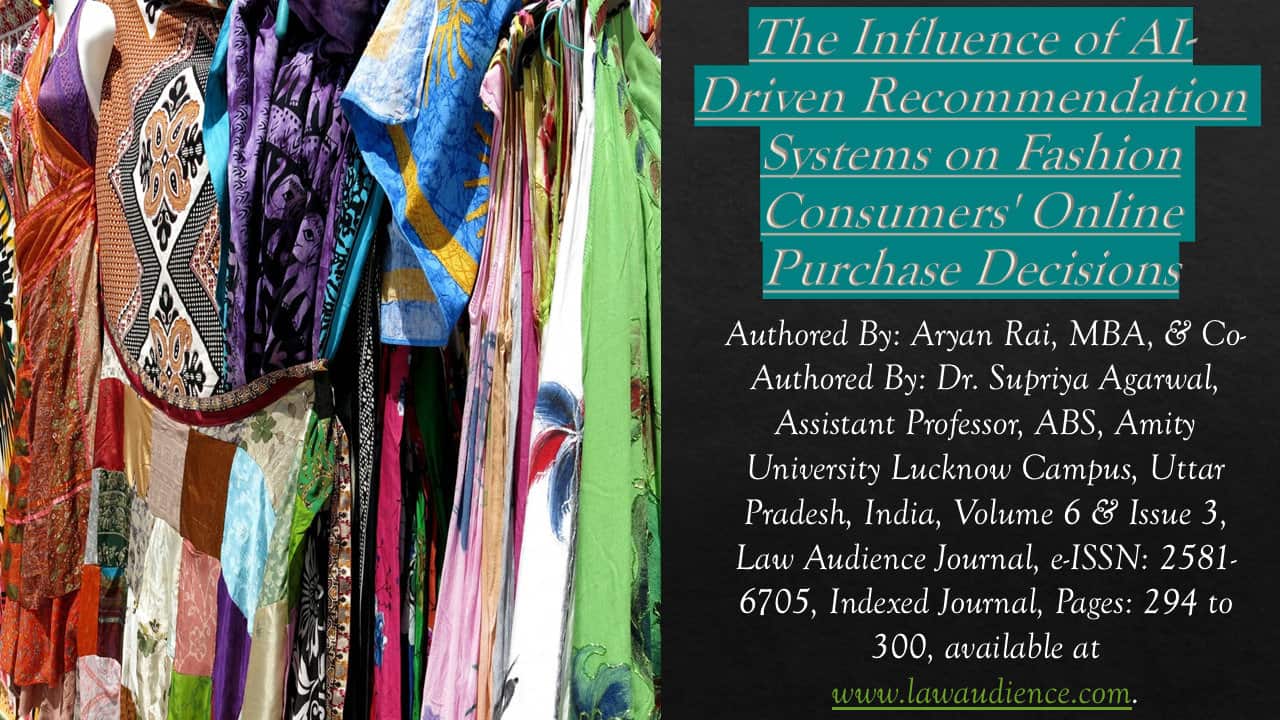
Authored By: Aryan Rai, MBA, & Co-Authored By: Dr. Supriya Agarwal, Assistant Professor, ABS, Amity University Lucknow Campus, Uttar Pradesh, India,
Click here for Copyright Policy.
ABSTRACT:
“The rapid digitization of retail has transformed the fashion industry, with artificial intelligence (AI)-driven recommendation systems emerging as critical tools for personalizing consumer experiences and influencing purchase decisions. This empirical study investigates how AI-powered recommendation engines affect online fashion consumers’ purchase behavior, satisfaction, and trust. Drawing on contemporary research, industry reports, and consumer feedback data from major fashion e-commerce platforms, the study examines the mechanisms through which collaborative filtering, content-based filtering, and deep learning algorithms shape shopping experiences. Analysis reveals that India’s fashion e-commerce sector, valued at USD 21.60 billion in 2025, is projected to reach USD 98.45 billion by 2032, with AI personalization contributing to conversion rate increases of 26-65%. Through a comprehensive review of empirical studies employing survey methodologies and structural equation modeling (SEM), this research identifies key factors—including perceived accuracy, trust, engagement, and privacy concerns—that mediate the relationship between AI recommendations and purchase intent. Findings indicate that while AI-driven personalization significantly enhances customer satisfaction and sales performance, challenges related to algorithmic bias, data privacy, and transparency require balanced approaches combining automation with human oversight”.
I. INTRODUCTION:
The global fashion industry has undergone a profound digital transformation, with e-commerce platforms rapidly displacing traditional brick-and-mortar retail. As of 2024, India emerged as the world’s second-largest e-retail market with 270 million online shoppers. The Indian fashion e-commerce sector demonstrates remarkable growth, anticipating a compound annual growth rate (CAGR) of 24.2% through 2032. This expansion brings heightened consumer expectations for seamless and highly personalized shopping experiences. AI-powered personalization leverages technologies such as machine learning, natural language processing (NLP), computer vision, and predictive analytics to analyze and anticipate consumer behavior patterns. By processing vast quantities of data—including browsing histories, past purchases, and visual preferences—these systems generate highly tailored product recommendations. Furthermore, virtual try-on experiences driven by augmented reality (AR) and AI allow consumers to visualize clothing, reducing the industry’s typical 30-40% return rates.
I.I PROBLEM STATEMENT:
Despite 92% of fashion brands planning increased AI spending, significant knowledge gaps and implementation challenges persist.
- Approximately 68% of consumers express uncertainty about algorithms tracking their activities without transparent disclosure.
- 74% of surveyed consumers desire greater clarity regarding why specific products are recommended.
- While investment intentions are high, only 1% of fashion brands have successfully implemented AI effectively to achieve tangible business outcomes.
- Existing empirical research on AI recommendation systems in fashion e-commerce remains fragmented, particularly within rapidly growing markets like India.
I.II RESEARCH OBJECTIVES:
This study aims to:
- Analyze the impact of AI-powered personalization on consumer experience, examining accuracy, relevance, and overall satisfaction.
- Examine how AI-driven recommendations influence purchase decisions, conversion rates, and average order values.
- Identify key technological and psychological factors that enhance customer satisfaction.
- Evaluate consumer perceptions regarding trust, transparency, and data privacy in AI systems.
- Provide evidence-based recommendations for fashion retailers to optimize AI strategies ethically.
II. LITERATURE REVIEW:
The emergence of AI has dramatically transformed fashion retailing by providing dynamic, customized shopping experiences.
II.I RECOMMENDATION SYSTEM ARCHITECTURES:
Fashion recommendation engines primarily utilize three algorithmic architectures:
- Collaborative Filtering: Analyzes user-item interactions to generate recommendations based on the preferences of similar users. Techniques like Singular Value Decomposition (SVD) and Nonnegative Matrix Factorization (NMF) establish these interactions. * Content-Based Filtering: Relies on product attributes (color, style, category) and user profiles to suggest similar items. It uses TF-IDF encoding and one-hot encoding for categorical attributes.
- Hybrid Approaches: Combine both collaborative and content-based filtering to address limitations like the “cold-start” problem for new users, improving overall diversity and accuracy.
II.II DEEP LEARNING IN FASHION RECOMMENDATIONS:
Advanced systems increasingly rely on deep learning, particularly Convolutional Neural Networks (CNNs), for image-based recommendations. *CNN models achieve 93.99% accuracy, with precision, recall, and F1-scores of 94% using Fashion-MNIST datasets.
- Advanced hybrid systems utilizing ResNet-50 for image feature extraction and BERT for text embeddings reach an impressive accuracy of 98.69%.
II.III TRUST, TRANSPARENCY, AND PRIVACY CONCERNS:
The literature identifies a strong need for “explainability” in AI models. Providing explanations for suggestions can increase a user’s perception of recommendation quality by 34%. Conversely, a lack of transparency leads to declines in user trust, with 68% of consumers uncertain about algorithm tracking. Furthermore, excessive personalization can feel invasive, and algorithms trained on biased historical data can reinforce stereotypes or result in discriminatory pricing.
III. METHODOLOGY:
This research adopts a quantitative, descriptive, and analytical approach grounded in secondary data synthesis.
- Data Sources: Primary studies (2022-2025) utilizing structured questionnaires, industry reports (e.g., McKinsey, Coherent Market Insights), and platform data (Myntra, Amazon Fashion).
- Sampling from Reviewed Studies: Sample sizes ranged from 100 to 400 respondents, primarily targeting online fashion shoppers (college students and young professionals) in Indian and international markets.
- Data Analysis Techniques: Studies employed sophisticated statistical analyses, including SPSS for data organization, Structural Equation Modeling (SEM) via Smart-PLS for testing direct and indirect effects, and multiple regression models. * Theoretical Frameworks: The research was grounded in the Technology Acceptance Model (TAM), Theory of Planned Behavior (TPB), and Trust-Building Theories.
IV. DATA ANALYSIS AND FINDINGS:
IV.I MARKET GROWTH AND ADOPTION:
Fashion e-commerce is experiencing exponential growth, transitioning into a dominant retail format. The specialized market for AI in fashion e-commerce is projected to reach USD 30 billion by 2028 globally.
IV.II IMPACT ON BUSINESS METRICS:
AI personalization delivers substantial, measurable improvements across diverse e-commerce metrics:
| Metric | Measured Impact | Attributed Cause |
| Conversion Rates | 65% Increase | AI voice personalization and virtual styling consultations. |
| Average Order Value | 55% Increase | Effective recommendations of complementary products. |
| Upsell Conversions | 27% Increase | Optimal timing and relevance of product suggestions. |
| Return Rates | 45% Reduction | Virtual try-on and personalized size recommendations. |
| Customer Satisfaction | 85% Score | Overall integration of AI-powered systems. |
IV.III STRUCTURAL RELATIONSHIPS AND CONSUMER BEHAVIOR:
Structural Equation Modeling revealed complex causal pathways for purchase decisions. Personalization influences purchase intent indirectly through perceived recommendation accuracy and trust. Trust serves as a critical mediating variable; accurate recommendations fail to drive conversions if consumers lack system confidence. Demographically, millennials and Gen Z consumers prioritize frequent interactions and personalized recommendations, reflecting a “digital-first” approach. In contrast, Gen X and Baby Boomers exhibit more deliberate shopping behaviors, prioritizing exclusive discounts and reliable sizing tools.
IV.IV THE TRUST AND IMPLEMENTATION GAP:
Despite high consumer interest—7 in 10 online shoppers desire to use AI within the next 12 months—a disconnect exists. While 92% of brands intend to invest in AI, only 1% successfully translate capabilities into business outcomes, revealing significant organizational and strategic barriers beyond standard algorithm development. Ethical concerns severely impact adoption, with algorithmic bias exposing retailers to reputational damage and legal risks.
V. STRATEGIC RECOMMENDATIONS:
Based on the empirical findings, the following actionable recommendations are provided for fashion e-commerce stakeholders:
V.I FOR FASHION RETAILERS:
- Adopt Hybrid Architectures: Implement hybrid systems combining collaborative filtering, content-based filtering, and deep learning (CNNs) to maximize accuracy up to 98.69%.
- Prioritize Explainable AI: Develop transparent interfaces that explain why products are suggested, addressing 74% of consumers desiring transparency and potentially improving perceived quality by 34%.
- Implement Segmented Personalization: Tailor strategies to demographics, utilizing trend-aware, visual recommendations for younger cohorts, and detailed, price-focused suggestions for older consumers.
- Integrate Virtual Try-Ons: Deploy AI and AR try-on features to mitigate fit uncertainty, targeting the demonstrated 45% reduction in return rates.
V.II FOR DATA PRIVACY AND ETHICS:
- Establish Transparent Governance: Implement clear data collection policies with explicit consent mechanisms and accessible privacy controls.
- Conduct Regular Bias Audits: Systematically audit algorithms using diverse datasets to prevent gender, body-type, and socioeconomic biases.
- Minimize Data Collection: Adopt data minimization and consider privacy-preserving alternatives like federated learning to build trust.
V.III FOR IMPLEMENTATION AND UX:
- Build Organizational Capabilities: Develop cross-functional AI teams (data science, marketing, IT) to bridge the 1% implementation success gap.
- Develop Conversational Interfaces: Implement AI chatbots utilizing NLP to provide real-time style guidance, enhancing satisfaction while reducing service costs.
- Provide User Control: Offer consumers the agency to adjust personalization intensity, including options like “show me something different”.
VI. CONCLUSION:
This study establishes that AI-driven recommendation systems exert a substantial positive influence on fashion consumers’ online purchase decisions. Measurable impacts include conversion rate increases of 26-65%, average order value improvements of 55%, and return rate reductions of 45%. These systems leverage sophisticated algorithms, particularly CNN-based models, to deliver highly personalized experiences at scale. With India’s fashion e-commerce sector projected to reach USD 98.45 billion by 2032, AI personalization has transitioned from an optional enhancement to a competitive necessity. However, sustainable success requires organizations to bridge the massive implementation gap by balancing algorithmic sophistication with human oversight, transparent data practices, and robust ethical frameworks.
Cite this article as:
Aryan Rai & Dr. Supriya Agarwal, “The Influence of AI-Driven Recommendation Systems on Fashion Consumers’ Online Purchase Decisions”, Vol.6 & Issue 3, Law Audience Journal (e-ISSN: 2581-6705), Pages 294 to 300 (9th March 2026), available at https://www.lawaudience.com/the-influence-of-ai-driven-recommendation-systems-on-fashion-consumers-online-purchase-decisions/.