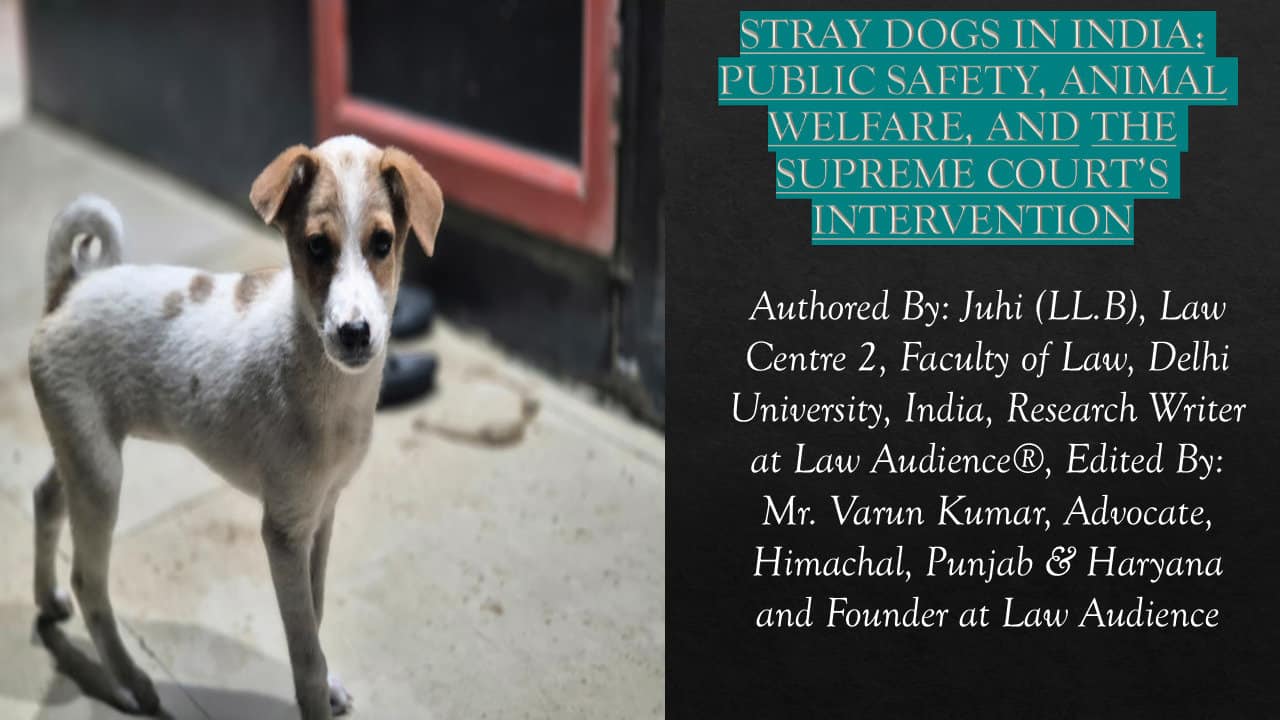
Authored By: Juhi (LL.B), Law Centre 2, Faculty of Law, Delhi University, India, Research Writer at Law Audience®,
Edited By: Mr. Varun Kumar, Advocate, Himachal, Punjab & Haryana and Founder at Law Audience
Introduction:
The presence of stray dogs in India has become a visible and often contentious urban issue. In many cities and towns, free-roaming dogs live in close proximity to human populations. For some residents, they are part of the neighbourhood ecosystem; for others, they represent a growing safety concern. The debate has intensified in recent years due to increasing reports of dog bite incidents and the continued risk of rabies transmission. At the same time, animal welfare advocates argue that any response must comply with constitutional values and statutory protections for animals. The Supreme Court of India has therefore been called upon to address this complex intersection of public health, municipal governance, and animal rights.
THE SCALE OF THE PROBLEM:
India has one of the largest populations of free-roaming dogs in the world. Government data indicates that dog bite cases number in the millions annually, with children being particularly vulnerable.1While rabies is preventable through vaccination, India continues to account for a significant proportion of global rabies deaths.2 These statistics have intensified public concern and prompted calls for stricter municipal control measures. Urbanisation has further complicated the issue. Rapid expansion of cities, improper waste management, and insufficient sterilisation infrastructure contribute to the growth and concentration of stray dog populations. Municipal corporations often struggle with limited veterinary staff, inadequate shelter facilities, and inconsistent implementation of sterilisation programmes. As a result, the challenge is not merely one of animal control, but of governance and resource allocation.
LEGAL FRAMEWORK GOVERNING STRAY DOGS:
The management of stray dogs in India is primarily governed by the Prevention of Cruelty to Animals Act, 1960 and the Animal Birth Control (Dogs) Rules, most recently revised in 2023.3 Under these Rules, stray dogs are not to be indiscriminately culled. Instead, they must be sterilised, vaccinated against rabies, and returned to their original location. Euthanasia is permitted only in cases of incurable illness or confirmed rabies infection. This regulatory framework reflects a policy choice favouring humane population control over elimination. However, the effectiveness of this approach depends heavily on consistent execution. Where sterilisation coverage is incomplete or irregular, populations may remain stable or even increase, leading to public dissatisfaction.
SUPREME COURT’S FINDINGS AND OBSERVATIONS:
In recent proceedings concerning rising dog bite incidents, the Supreme Court examined the adequacy of existing mechanisms and the responsibilities of state authorities. The Court acknowledged that public safety is a legitimate concern and emphasised that citizens cannot be left vulnerable to preventable harm.4At the same time, it reiterated that animal welfare laws remain binding and must be implemented in good faith.
One of the Court’s significant observations was that authorities cannot ignore either dimension of the problem. Municipal bodies were reminded of their statutory duty to implement the Animal Birth Control programme effectively, including vaccination and sterilisation drives.5 The Court has also stressed coordination between local governments and animal welfare boards to ensure scientific management rather than ad hoc responses.
Importantly, the Court clarified that rabid or dangerously aggressive dogs may be isolated in accordance with law, but healthy sterilised dogs are generally to be returned to their original habitat, consistent with the governing Rules.6This position attempts to maintain equilibrium between the right to life and safety under Article 21 of the Constitution and the duty to show compassion to living creatures under Article 51A(g).
The Court has further emphasised accountability, cautioning state authorities against administrative delay and inadequate compliance. Its approach suggests that the real issue lies less in the legal framework and more in the implementation gap.
BALANCING RIGHTS AND RESPONSIBILITIES:
The stray dog debate often becomes polarised, with one side advocating complete removal and the other insisting on unrestricted protection. However, the Supreme Court’s reasoning indicates that neither extreme is sustainable. Public safety, particularly for children and elderly citizens, must be ensured. Simultaneously, the law does not permit indiscriminate killing of animals as a method of population control.
Long-term solutions require systemic reform rather than reactive measures. These include expanding sterilisation capacity, ensuring annual anti-rabies vaccination coverage, improving waste disposal systems, and promoting responsible pet ownership to prevent abandonment. Community awareness programmes can also reduce conflict by educating residents about safe interaction and reporting mechanisms.
CONCLUSION:
The issue of stray dogs in India illustrates the tension between compassion and security in a densely populated society. The Supreme Court has sought to navigate this tension by reinforcing both statutory animal protection norms and the constitutional imperative of public safety. Its findings make clear that humane treatment and effective governance are not mutually exclusive. The responsibility now rests with municipal authorities, state governments, and civil society to translate judicial directions into practical, measurable outcomes.
A sustainable response will not emerge from confrontation but from coordinated action grounded in law, science, and civic responsibility.
Footnotes:
1 Ministry of Health and Family Welfare, Government of India, National Rabies Control Programme data (recent annual reports).
2 World Health Organization, “Rabies Fact Sheet,” Global Health Observatory Data.
3 Animal Birth Control (Dogs) Rules, 2023, issued under the Prevention of Cruelty to Animals Act, 1960.
4 Supreme Court of India, recent proceedings concerning stray dog management and public safety (2024–2025 hearings).
5 Ibid., directions to municipal and state authorities regarding implementation of sterilisation and vaccination programmes.
6 Ibid., clarification on treatment of rabid or aggressive dogs under existing legal provisions.