Click here to download the full paper (PDF)
Authored By: Mr. Tabish Malik, Scholar, & Co-Authored By: Dr. Khushboo Agnihotri, Assistant Professor, ABS, Amity University Lucknow Campus, Uttar Pradesh, India,
Click here for Copyright Policy.
ABSTRACT:
“Artificial Intelligence (AI) has revolutionized the digital marketing ecosystem by enabling hyper-personalization, predictive analytics, and automated customer engagement. This research paper examines the role of AI in shaping personalized digital marketing strategies and its impact on customer satisfaction, brand loyalty, and business performance. The study explores AI technologies such as machine learning, natural language processing, chatbots, recommendation engines, and predictive analytics used in modern marketing platforms like Google Ads, Meta Ads Manager, and Amazon’s Recommendation System. The research adopts a quantitative methodology based on survey responses from 50 participants. Findings indicate that AI-driven personalization significantly influences customer purchase decisions and enhances user engagement. The study concludes that AI is not just a technological tool but a strategic necessity in modern marketing”.
Keywords: Artificial Intelligence, Digital Marketing, Personalization, Machine Learning, Consumer Behaviour, Predictive Analytics
I. INTRODUCTION:
Digital marketing has evolved from mass communication to personalized engagement. Traditional marketing strategies relied heavily on demographic segmentation; however, with technological advancements, marketers now use Artificial Intelligence to analyze large volumes of consumer data in real time. Companies such as Amazon, Google, and Meta Platforms leverage AI to deliver tailored advertisements, product recommendations, and customized user experiences. Personalized digital marketing refers to the practice of using customer data to deliver individualized messages, offers, and product recommendations. AI enhances this by:
- Analyzing user behavior
- Predicting purchase intent
- Automating content customization
- Optimizing advertising campaigns
II. LITERATURE REVIEW:
Several scholars have emphasized the growing role of AI in marketing:
- Kotler & Keller (2016) suggested that marketing is shifting toward data-driven personalization.
- Davenport et al. (2020) argued that AI enables firms to gain competitive advantage through predictive customer insights.
- Chaffey (2022) highlighted AI-powered automation in digital advertising.
Studies reveal that AI-based recommendation systems (like those used by Netflix) improve customer retention rates by over 30%.
The literature confirms:
- AI increases targeting accuracy
- AI improves ROI on digital campaigns
- Consumers prefer personalized experiences
However, concerns exist regarding data privacy and ethical implications.
III. PROBLEM STATEMENT:
Despite widespread adoption of AI tools in digital marketing, there remains limited understanding among small and medium enterprises regarding:
- Implementation challenges
- Cost-effectiveness
- Ethical considerations
- Consumer trust issues
This study aims to evaluate the effectiveness of AI in personalized digital marketing strategies.
IV. OBJECTIVES OF THE STUDY:
- To analyze the role of AI in personalized digital marketing.
- To examine consumer perception toward AI-driven advertisements.
- To measure the impact of AI personalization on purchase intention.
- To identify challenges in AI implementation.
V. RESEARCH METHODOLOGY:
V.I RESEARCH DESIGN:
Descriptive and analytical research design.
V.II DATA COLLECTION:
- Primary Data: Questionnaire survey (50 respondents)
- Secondary Data: Journals, articles, company reports
V.II SAMPLING METHOD:
Convenience sampling
V.IV TOOLS USED:
- Structured questionnaire
- Statistical percentage analysis
VI. DATA ANALYSIS AND INTERPRETATION:
Sample Size: 50 Respondents
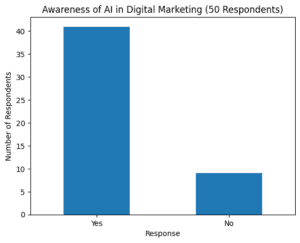
1️. Awareness of AI in Digital Marketing
- 41 respondents (82%) are aware of AI in digital marketing.
- 9 respondents (18%) are not aware.
🔎 Interpretation:
The majority of respondents are familiar with AI-based marketing techniques. This indicates strong digital exposure and growing technological awareness among consumers. High awareness suggests that AI-driven marketing strategies are already influencing the mainstream audience.
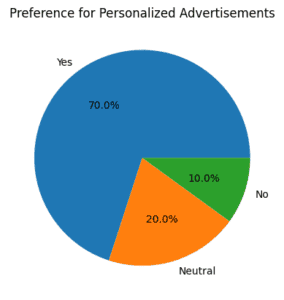
2️. Preference for Personalized Advertisements:
- 70% prefer personalized ads
- 20% are neutral
- 10% do not prefer personalized ads
🔎 Interpretation:
A significant majority prefer personalized advertisements. This confirms that AI-powered targeted marketing increases user relevance and engagement. However, 30% (neutral + no) indicate that personalization must be balanced carefully to avoid being perceived as intrusive.
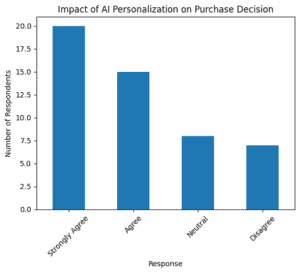
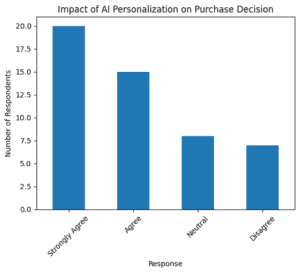
3️. Impact of AI Personalization on Purchase Decision:
- 20 (40%) Strongly Agree
- 15 (30%) Agree
- 8 (16%) Neutral
- 7 (14%) Disagree
🔎 Interpretation:
70% of respondents agree that AI-based personalization influences their purchasing decisions. This strongly supports the hypothesis that AI-driven recommendations and targeted ads increase conversion rates and sales effectiveness.
The neutral and disagree responses suggest:
- Some consumers are skeptical.
- Not all personalized marketing directly leads to purchase.
- Brand trust still plays an important role.
4️. Level of Data Privacy Concern:
- 22 (44%) High Concern
- 18 (36%) Moderate Concern
- 10 (20%) Low Concern
🔎 Interpretation:
Although consumers prefer personalization, a majority (80%) have moderate to high concerns about data privacy. This highlights a critical challenge for companies:
✔ AI improves engagement.
❗ But privacy transparency is essential
Organizations must implement ethical AI policies and clear data usage guidelines to maintain trust.
📌 Overall Findings Summary:
- AI awareness is high among consumers.
- Personalized marketing is widely preferred.
- AI significantly influences purchase decisions.
- Data privacy remains a major concern.
- Businesses must balance personalization with ethical data practices.
VII. DISCUSSION:
The findings indicate that AI enhances customer engagement and satisfaction. Platforms like Spotify use AI to curate playlists based on user listening history, thereby increasing retention.
AI contributes to:
- Real-time behavioral targeting
- Dynamic content optimization
- Customer journey mapping
- Chatbot-based instant response systems
However, ethical challenges such as data misuse and algorithmic bias must be addressed.
VIII. FINDINGS:
- AI-driven personalization increases consumer engagement.
- AI-based recommendations improve sales conversion rates.
- Consumers are more likely to interact with customized content.
- Data privacy concerns remain a significant issue.
IX. CONCLUSION:
Artificial Intelligence plays a transformative role in personalized digital marketing strategies. It enables businesses to understand consumer behaviour deeply and deliver tailored experiences at scale. AI technologies such as machine learning, predictive analytics, and recommendation engines enhance marketing efficiency and return on investment. In the era of digital transformation, AI is no longer optional but essential for competitive advantage. However, organizations must balance personalization with data privacy and ethical transparency.
X. RECOMMENDATIONS:
- Businesses should invest in AI-based CRM systems.
- Transparent data policies must be implemented.
- SMEs should adopt affordable AI marketing tools.
- Continuous monitoring of AI algorithms to prevent bias.
XII. LIMITATIONS OF THE STUDY:
- Small sample size (50 respondents)
- Limited geographical scope
- Self-reported data may contain bias
Cite this article as:
Mr. Tabish Malik & Dr. Khushboo Agnihotri, “Role of Artificial Intelligence in Personalized Digital Marketing Strategies”, Vol.6 & Issue 3, Law Audience Journal (e-ISSN: 2581-6705), Pages 269 to 278 (9th March 2026), available at https://www.lawaudience.com/role-of-artificial-intelligence-in-personalized-digital-marketing-strategies/.
References:
- Kotler, P., & Keller, K. L. (2016). Marketing Management. Pearson Education.
- Davenport, T., Guha, A., Grewal, D., & Bressgott, T. (2020). How AI Will Change the Future of Marketing. Journal of the Academy of Marketing Science.
- Chaffey, D. (2022). Digital Marketing Excellence. Routledge.
- Various company reports from Amazon, Google, Netflix, and Spotify.