Click here to download the full paper (PDF)
Authored By: Mishra Chandanben Virendrakumar, Research Scholar, University School of Law, Gujarat University, Ahmedabad, Gujarat,
Click here for Copyright Policy.
Guide: Dr. Dilip A. Mevada, RET. Principal, Siddharth Law College, Gandhinagar, Gujarat University
PURPOSE:
On 15th August 2025 India going to celebrate 78th Independence Day & was celebrated 75th year of republic of India. Here we are rising a concern about India really getting independence from inequality of Caste, Creed, Language and socio-economic classes. This empirical study paper perusing the following questions.
- How much Articles 14,15,16 of Indian Constitution impacted in Indian citizen daily life.
- Is Reservation policies of India eliminated caste system bias and Caste Neutral Ideal or Caste Specific.
- Is Socio-economic uplift happened from pre independence to 2025.
- Are depressed sections of enjoying their birth rights.
I. INTRODUCTION:
The Satya Shodhak Samaj called as Society of Truth Seekers was a prominent social reform society founded by Jyoti Rao Phule in Pune, Maharashtra, on September 24,1873. Challenging upper caste supremacy and dominance in the society and advocated other backward classes unity against supremacy of socio- economic communities at that time. It was later developed and grounded seed for reservation movement in India from Kolhapur in Maharashtra State. The colonial administration largely avoided caste-based policies, focusing instead on religious communities (Hindus, Muslims, Sikhs, etc.). In Pre Independence India, The Poona Pact (1932) a turning point in India’s Reservation was a historic agreement between Dr. B.R. Ambedkar (representing Dalits) and Mahatma Gandhi (representing the Indian National Congress) that shaped India’s system of political representation for marginalized castes. The Pact is the historical pivo from threatened fragmentation to the modern “one electorate, reserved seats” model. Key resolutions from Poona pact were Joint (general) electorates, but with reserved seats for Depressed Classes in provincial legislatures 148 seats (nearly double the Award’s 71) allocated among provinces. Primary elections for Depressed Class voters would first elect a panel of four candidates; the two highest would stand in the general election—an attempt to keep community choice alive. Representation in Central Legislature: 18% of the British Indian seats reserved for Depressed Classes. Fair representation in public services and grant-in-aid for education of Depressed Classes. In 1950 Republic of India drafted reservation system, enshrined in the Constitution under Articles 15 and 16, was introduced to uplift historically marginalized communities—Scheduled Castes (SCs), Scheduled Tribes (STs), and Other Backward Classes (OBCs). India’s reservation policy, designed to address historical caste-based discrimination, remains a contentious issue. While proponents argue that caste-based reservations are essential for social justice, critics advocate for caste-neutral policies focusing on economic criteria. This paper examines the debate between caste-conscious and caste-neutral reservation systems, analysing their implications on social equity, meritocracy, and political discourse. Using empirical data and policy analysis, the study evaluates whether India should transition to an economic-based reservation model or retain caste as a primary criterion for affirmative action.
II. HOW MUCH ARTICLES 14,15,16 OF INDIAN CONSTITUTION IMPACTED IN INDIAN CITIZEN DAILY LIFE:
From the Independence till now India crossed many waves succesfully including latest 2019 Corona with great spirt . Still forwarding with same spirit and a 15 days of bankrupt country to 5th largest economy globollay with dramatically increrased lietracy rate of 77.7 % form just 12% from independence. All this happened from the policies of every gevernment passing from independence till now. Reservation policy of India not only uplifting depressed classes and also upliftimg ecnomical rise along with that.
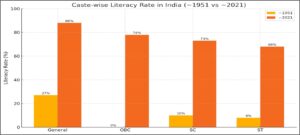
Source: Census 1951, NSO 2021, UDISE+ 2021–22, NFHS-5; OBC data is based on NSSO estimations since 1990.
From the 1951 introduction of caste-based reservation policy voice out opportunity to all depressed class in education as of latest census in 2021 SC/ST literacy rate rising 7.3 times and 6.8 times exponentially. As Per National Average (Census 2011) India’s overall literacy rate is 74%, with men at 82.1% and women at 65.5%. The literacy rate for SCs is 66.1%, with men at 75.2% and women at 56.5%. STs have a literacy rate of 59%, with men at 68.5% and women at 49.4%. Other Backward Classes (OBC): Estimated at 68% (NSSO 2017-18), with men (~77%) outperforming women (~58%). General Category Literacy is highest here, estimated at 80-85%, with upper castes. The national average literacy rate for SCs in 2011 was 66.07%, which was below the overall national literacy rate of 74%.
III. IS RESERVATION POLICIES OF INDIA ELIMINATED CASTE SYSTEM BIAS AND CASTE NEUTRAL IDEAL OR CASTE SPECIFIC:
In recent trends (NFHS-5, 2019-21) SC/ST Literacy has risen slightly, but gaps persist (SCs ~12-15% behind general category; STs ~18-20% behind).SC/ST women lag the most (~50-56% literacy vs. ~75% for general category women.Upper OBCs (Yadavs, Kurmis) reach 70-75%, while Most Backward Classes (MBCs) remain at 60-65%. Resrervation policy of India prioritzing education and economical equality among all classes of India. But somewhere still lagging in elimation of caste based bias in all levels of soceity. Untouchability , honor killing in intercaste marriages, rural-urban divide are some issues not only make citizen caste consuics but paving road to diminshing the brighten side reservation policy given to soceity.
India continues to face a pronounced rural-urban divide, with educational inequality playing a central role in sustaining this gap. As per the “Periodic Labour Force Survey 2023”, around 26.3% of the population remains without basic literacy. Although the percentage of individuals with education below the primary level has slightly dropped—from 12.5% in 2016 to 11.5% in 2023—this improvement is largely restricted to urban areas. The persistence of this disparity poses a significant barrier to achieving inclusive and balanced development. It highlights the pressing need to enhance educational opportunities and infrastructure in rural regions. Nationally, the Education Gini Index—a tool used to assess inequality in education—has shown improvement, decreasing from 72.4% in 1986 to 46.6% in 2023. This indicates a gradual narrowing of educational gaps across the country. However, the level of inequality remains considerable. Furthermore, while every state has reported some degree of progress, trends in certain regions raise concerns and call for focused policy measures to bridge these educational disparities.
IV. IS SOCIO-ECONOMIC UPLIFT HAPPENED FROM INDEPENDENCE TO 2025:
| Year | Development | Impact |
| 1951 | 1st Amendment added Article 15(4) after Champakam Dorairajan case. | Enabled caste-based reservations in education. |
| 1976 | 42nd Amendment expanded “backward classes” definition. | Paved way for Mandal Commission. |
| 1992 | Indra Sawhney verdict upheld OBC quotas under Article 16(4). | Established 50% rule & creamy layer. |
| 2019 | 103rd Amendment added Article 15(6) & 16(6) for EWS (10% quota). | Extended reservations to economically weak upper castes. |
India’s reservation policy has played a significant role in socio-economic upliftment, particularly for marginalized communities. Since its introduction, it has helped Scheduled Castes (SC), Scheduled Tribes (ST), and Other Backward Classes (OBC) gain access to education, employment, and political representation. In various timeline from 1951 1st Amendment added Article 15(4) after Champakam Dorairajan case enabled reservation in education. In 1976 42nd Amendment expanded “backward classes” paved way for Mandal Comission. Eveb after two decades of agitaion mandal commission recommendtions was upheld by Superme court in 1992 Indra Sawhney verdict upheld OBC quotas under Article 16(4) provided 27 % reservation to BC category by elimating creamy layer provision. By 2019 Latest improvement by introducing EWS – Economic Weaker Section 10% reservation for ecomically weak in upper caste who are all coming under general category in eduaction and employment. By providing reservation in education laid the road to employment and its rooted to social economical upliftment. Depressed category worked as scavangers, manual labours in times got their birth right in constution made them today The president of India, the chief justice of India, various MLA & MP who activetly partcipated in law making and acting as guardimg of the constituion seeded by Dr. B R Amdebkar. As resulted of Mandal commission implementation OBC got more represensatives in state assemblies and Parliament.
V. ARE DEPRESSED SECTIONS OF ENJOYING THEIR BIRTH RIGHTS:
Reservations expanded access to education and jobs, creating an SC/ST/OBC middle class, but structural inequalities persist. While urban, educated Dalits/OBCs have benefited, rural and marginalized groups still face exclusion. The policy’s success lies in representation, but economic and social equality remain unfinished goals. Reservations lifted millions, but outcomes vary by state. Southern states prove that quotas,social reforms (land, education) yield the best results. North/central India needs better enforcement, while tribal areas require targeted welfare. Reservations have had varying impacts across states, depending on implementation, political will, and historical caste dynamics. States like Tamil Nadu having 69% of reservation succesfully implemnted and out performed any other states but opposing implemention of EWS even after Superme court upheld. Tamil Nadu Education SC literacy rose from 10% (1951) to 80% (2024) (highest among major states). OBC enrollment in engineering/medical colleges 50% (2024). SC/ST representation in state jobs 20% (SCs), 1.5% (STs) (2023). Kerala Education SC literacy 85% (2024) vs. national SC avg. of ~70%. And ST literacy improved from 5% (1951) to 75% (2024). Employment of SC/STs form 15% of state govt jobs (2024). Unique Factor about Keral Land reforms (1950s) and strong public education reduced dependency on quotas. States like Gujarat doesn’t have availability of data in public forums. But Punjab is highest propation of SC/ST population in India and more than 30% on state census as of 2011. And litercay rate is 72% on par with state avg. 76% but also close in unemplyed rate 7% compared to national avg. 8.1%. Uttar Pradesh has 4 cr. Depressed class population highest in number in India and 21% in state population but particular community like Jatavs mostly utuilizing the reservation. And highest obc population in India and around 45% in state population playing a major in politics not only in UP and also in national level. Community like Yadavas polarazing the resrvation benefits through political domination but still lagginng in economic uplift of community. Bihar, the state that brought commision to India and most populated OBC community in India 63% was failing in implemation of resrvation benefits by poltical domiance of few families in the state. Lagging in all census and less than all national avgerage rate of litercay , education, and ecnomoical upliftment of communities.
VI. RECOMMENDATIONS:
Reservation in India is a zero sum game. “Reservations are not a poverty alleviation scheme but a right to representation” a great saying by Dr. BR Ambedakar. From poona pact time to still now resrvation policies are under played as a political tool to gather commuinty represenation in polictics. In 1951 Champakam Dorairajan was a Brahmin woman from Madras. This is explicitly mentioned in several sources discussing the case. She was denied admission to a medical college despite having good grades due to the existing caste-based reservation policies, which led her to challenge the government order in court. She went to Court and brought 1st Amendment added Article 15(4) to enabale resrvation in Education. Straight after 50 years Janhit Abhiyan vs. Union of India (2022) case. This was the primary case that challenged the constitutional validity of the 103rd Constitutional Amendment Act, 2019, which introduced a 10% reservation for EWS in education and employment. The Supreme Court, in a 3:2 majority verdict on November 7, 2022, upheld the constitutional validity of the EWS reservation. while the central government mandates a 10% EWS reservation, but Tamil Nadu has not adopted this for state-level opportunities, citing its existing comprehensive reservation policy. Residents of Tamil Nadu who meet the EWS criteria can still avail the EWS reservation for central government jobs and institutions. Policy maker should think Nation First idealogy more than community first when they come to national building.
This study recommending:
- Time being mertics of taking advantage reservation should reduced in all level after two generations in OBC and three generation to SC communties. It helps to add more benefinacry inside the community
- Should implement rotation based poltical representaion community wise to stop single commuity domination in politics.
- Should introduce Creamy layer in SC to stop over utilzation on reservation.
References:
Deshpande, A. (2023). The Mandal revolution and after. Economic and Political Weekly.
Galanter, M. (1984). Competing equalities: Law and the backward classes in India. University of California Press.
Jaffrelot, C. (2003). India’s Silent Revolution: The Rise of the Lower Castes in North India. C. Hurst & Co.
Subrahmanian, R. (2020). Access, discrimination and affirmative action in Indian higher education. Economic and Political Weekly, 55(11), 47–53.
Government of India. (1951–2021). Census Reports. Office of the Registrar General & Census Commissioner.
Ministry of Statistics and Programme Implementation. (2023). Periodic Labour Force Survey (PLFS).
National Family Health Survey (NFHS-5). (2019–21). International Institute for Population Sciences.
Supreme Court of India. (1992). Indra Sawhney vs Union of India.
Supreme Court of India. (2022). Janhit Abhiyan vs Union of India.
Cite this article as:
Mishra Chandanben Virendrakumar, “Reservation Policy in India: Policy Expectation vs Specific Realities” Vol.6 & Issue 1, Law Audience Journal (e-ISSN: 2581-6705), Pages 273 to 281 (12th July 2025), available at https://www.lawaudience.com/reservation-policy-in-india-policy-expectation-vs-specific-realities/.