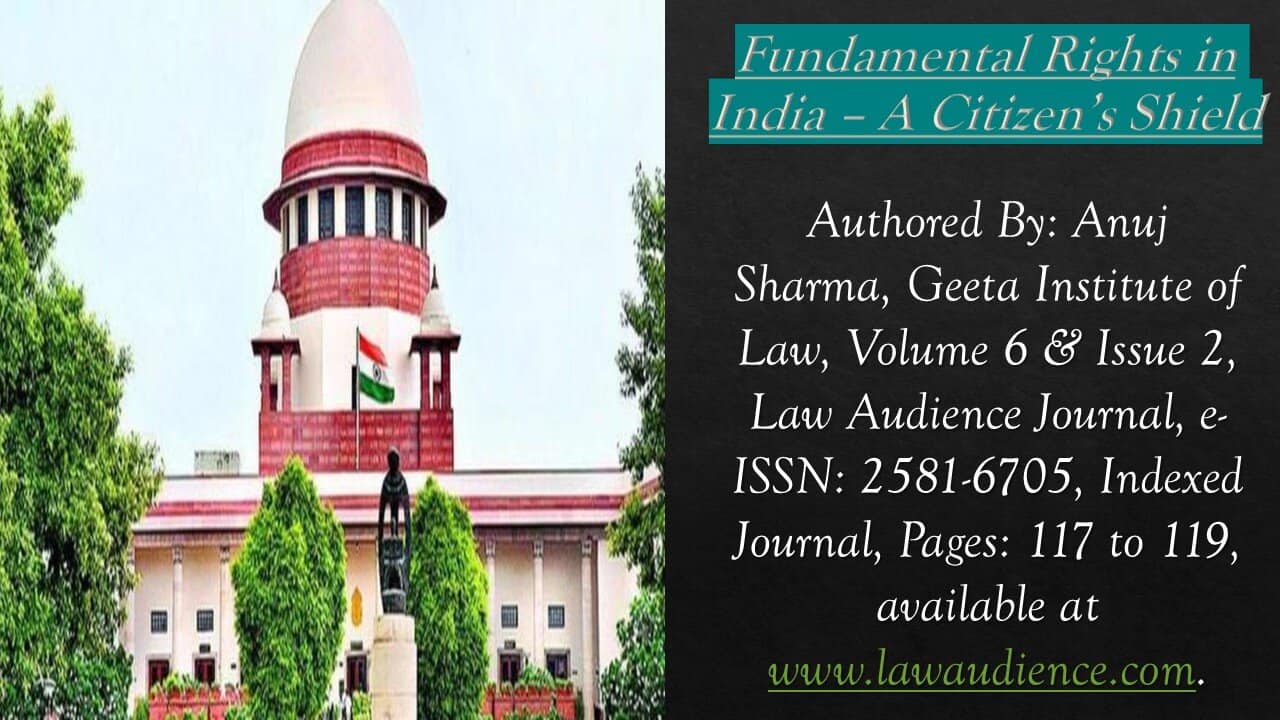
Click here to download the full paper (PDF)
Authored By: Anuj Sharma, Geeta Institute of Law,
Click here for Copyright Policy.
ABSTRACT:
Fundamental Rights are the backbone of the Indian Constitution. They protect individual liberty and ensure justice in a democratic society. This article explores the nature, scope, and importance of these rights, especially from the perspective of young citizens entering the legal field.
I. INTRODUCTION:
As a first-year law student, I’ve come to realize how deeply Fundamental Rights shape our understanding of justice and citizenship. These rights are not just legal provisions; they are moral commitments that define the relationship between the State and its people. Enshrined in Part III of the Constitution, they empower individuals to live with dignity and freedom.
II. TYPES OF FUNDAMENTAL RIGHTS:
The Constitution of India guarantees six major Fundamental Rights:
- Right to Equality (Articles 14-18):
Ensure equal treatment before the law and prohibit discrimination.
- Right to Freedom (Articles 19-22):
Includes freedom of speech, movement, profession, and protection from arbitrary arrest.
- Right against Exploitation (Articles 23-24):
Prohibits forced labor and child labor.
- Right to Freedom of Religion (Articles 25-28):
Allows individuals to practice, profess, and propagate any religion.
- Cultural and Educational Rights (Articles 29- 30):
Protects the rights of minorities to preserve their culture and establish educational institutions.
- Right to Constitutional Remedies (Article 32):
Empowers citizens to approach the Supreme Court directly if their rights are violated.
III. IMPORTANCE FOR STUDENTS:
Understanding these rights is crucial for students, especially those studying law. It helps us:
- Grasp the foundations of democracy and justice.
- Recognize and challenge social inequalities.
- Build awareness of legal protections available to every citizen.
In contrast to textbook definitions, these rights come alive when we see them applied in real-life situations from protests to privacy debates.
IV. JUDICIAL SUPPORT:
The judiciary has played a vital role in interpreting and expanding the scope of Fundamental Rights. Two landmark cases illustrate this:
- Maneka Gandhi vs. Union of India (1978)[1]:
The Supreme Court held that the right to personal liberty under Article 21 must be interpreted broadly, linking it with Articles 14 and 19.
- Kesavananda Bharati vs. State of Kerala (1973)[2]:
This case established the “basic structure doctrine,” ensuring that Fundamental Rights cannot be amended in a way that destroys their essence.
These judgments show how the Constitution evolves through judicial interpretation, keeping pace with changing societal needs.
V. CONCLUSION:
In my view, understanding Fundamental Rights early in our legal education empowers us to become responsible advocates of justice. These rights are not just tools for legal protection – they are instruments of social transformation. As future lawyers, it is our duty to uphold and defend them, both inside and outside the courtroom.
Cite this article as:
Anuj Sharma, “Fundamental Rights in India – A Citizen’s Shield”, Vol.6 & Issue 2, Law Audience Journal (e-ISSN: 2581-6705), Pages 117 to 119 (8th Nov 2025), available at https://www.lawaudience.com/fundamental-rights-in-india-a-citizens-shield/.
References:
- Constitution of India
- Maneka Gandhi vs. Union of India, AIR 1978 SC 597
- Kesavananda Bharati vs. State of Kerala, AIR 1973 SC 1461
[1] AIR 1978 SC 597.
[2] (1973) 4 SCC 225; AIR 1973 SC 1461.