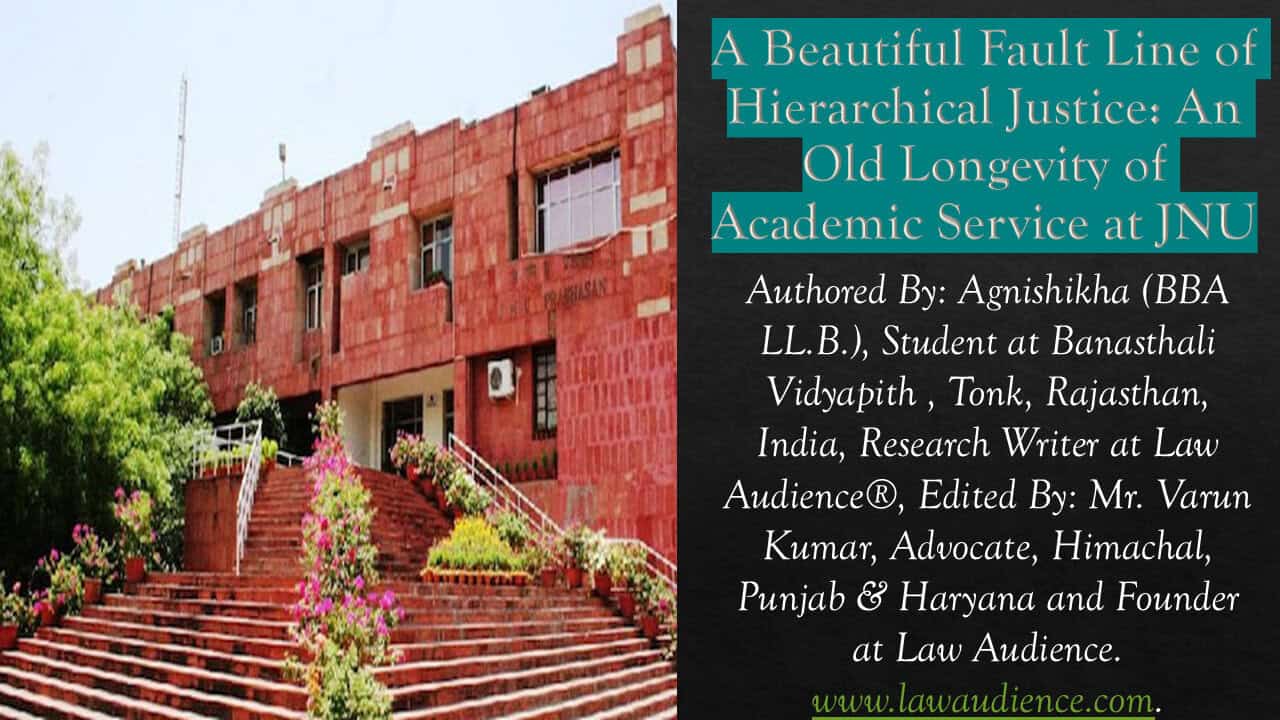
Authored By: Agnishikha (BBA LL.B.), Student at Banasthali Vidyapith , Tonk, Rajasthan, India, Research Writer at Law Audience®,
Edited By: Mr. Varun Kumar, Advocate, Himachal, Punjab & Haryana and Founder at Law Audience.
On 17 April 2025, a conundrum of silent efforts of an institution of rather great eminence came serenely, yet erroneously, against the independent claims of one of its own professionals from within its premises; within a matrix of reputational seriousness that coloured both the learner and the teacher in a collision of damages, though not of similar claims and certainly not of similar damages.
Around May 2024, an anonymous complaint under the Sexual Harassment of Women at Workplace (Prevention, Prohibition and Redressal) Act, 2013 was filed against Professor Swarna Singh, who at that time, during the foundational build-up of the matter, was still serving in his professional responsibilities within the campus of Jawaharlal Nehru University. This consequently did neither threaten the result of his contribution to the institution as long as he was accrediting serving and was remaining relevant. According to JNU’s official records, the professor had been a member of the institution for more than two decades, carrying with him a record of academic brilliance and institutional contribution.
Surely, and not surprisingly, the Indian public, especially young academic minds often consolidate trust in the reality of central academic reputations. Experience and institutional association become an edge. But when such personalities enter the field of allegations, particularly those carrying absolute suspicion of institutional guilt, the face of the institution itself is pressed to respond whether to take the back of the professor, or to cut through its own credibility in order to preserve it.
This remains deeply rooted beyond the scope of law alone. The awareness of the author rests equally within the damage that allegations carry damages that are not only intimate at their opening but are sustained even in dismissal. On the effect of proof, or even its anticipation, the professor was immediately removed from service. Under its own procedural framework and the localized functioning of the ICC, this appeared to be projected as a statement of institutional strength—yet it simultaneously opened questions of administrative diligence and calibrated response.
The matter of Professor Swarna Singh v. JNU and others stands as a classic instance of the intersectional strain between individual rights of foundational dignity and the protective framework of POSH, against the violation or perceived violation of fair procedural interests of the accused. Justice Dutta, in engaging with the matter, seems to have carried the weight of this aggregation, where the grievance was not merely reputational but extended into the abruptness of termination, the denial of accrued benefits, and the misalignment with the professor’s long-standing service record.
It is both aggravating and premature to view this case merely as a contest between private interest and individual reputation. Beyond the primary confusion of claims lies a deeper institutional question of permanence of academic service, of reputational inheritance, and whether such standing can be burdened, or even displaced, solely on the basis of material accusations that remain unproven at their core.
On such grounds, the nature of severance itself becomes questionable whether the abruptness reflects necessity, or whether it reveals an absence of measured correspondence to the longevity and continuity of the teacher’s service.
In drawing this to a close, the observations attributed to Justice Dutta do not settle the discomfort of the matter; rather, they deepen it. His lines appear not as a declaration of vindication, but as a caution against the ease with which institutional response may outpace procedural certainty. The emphasis, as it emerges, is not upon disproving the allegation, nor upon diminishing its gravity, but upon questioning whether the immediacy of institutional action had sufficiently corresponded with the requirements of fairness, proportionality, and due consideration.
It is here that the neutrality of the court assumes significance. The judicial voice does not substitute itself for the mechanism under the Sexual Harassment of Women at Workplace (Prevention, Prohibition and Redressal) Act, 2013, nor does it displace the autonomy of the institution. Instead, it intervenes at the level of balance where the right to a safe and dignified workspace must coexist with the equally foundational right to reputation and fair process.
The case of Professor Swarna Singh and Jawaharlal Nehru University, therefore, resists singular moral reading. It does not rest comfortably within binaries of right and wrong, nor within the immediacy of institutional defence or individual grievance. What it leaves behind is a more unsettled, yet necessary, inquiry whether the structures designed to protect can, in their urgency, also risk pre-empting the very fairness they are meant to uphold.
And perhaps, in that unresolved space, lies the truest conclusion: not of answers, but of an ongoing obligation upon institutions, upon law, and upon those who interpret both to remain measured, even when the moment demands immediacy.
Running parallel to this question of proportionality lies another, more delicate fracture within the statutory framework itself—that of confidentiality and controlled disclosure. The Sexual Harassment of Women at Workplace (Prevention, Prohibition and Redressal) Act, 2013, under Section 16, places an explicit embargo on the publication or disclosure of the identity of the aggrieved woman, the respondent, and the contents of the inquiry proceedings. This prohibition is neither incidental nor procedural it is foundational to preserving the dignity, privacy, and psychological security of all parties involved, particularly within institutional environments where reputational consequences travel swiftly and often irreversibly.
Yet, the statute does not remain absolute in its silence. Through its proviso, it carves out a narrow but significant exception: the dissemination of information relating to the justice secured without disclosing identities is permissible. This legislative design attempts to strike a balance between transparency and protection, allowing institutions to demonstrate accountability without compromising the individuals at the centre of the dispute.
However, it is precisely within this calibrated allowance that a new tension emerges. In practice, the line between disclosure and identification is not always easily maintained. In closely-knit academic ecosystems such as that of Jawaharlal Nehru University, where hierarchies are visible and professional identities are deeply embedded within public knowledge, even anonymised disclosures may carry the potential of indirect identification. The reputational weight borne by a long-serving academic, when placed alongside institutional action that is visible in effect if not in name, can render confidentiality more formal than real.
In the case at hand, this raises a critical question: whether the spirit of Section 16 was preserved in substance, or merely in form. If institutional action—such as removal from service—becomes publicly perceptible, does the non-disclosure of name sufficiently safeguard the respondent’s identity? Or does it, in effect, create a paradox where the law protects identity in text, while institutional realities expose it in practice?
At the same time, the proviso permitting disclosure of “justice secured” introduces its own asymmetry. The narrative of justice, when released into the public domain, is often received without the accompanying nuance of procedural complexity. It risks constructing a perception of conclusiveness even where the process itself remains contested. In such circumstances, the accused may find themselves situated within a publicly affirmed outcome, without an equivalent space to contest the manner in which that outcome was reached.
This duality of mandated silence and selective disclosure—therefore does not merely regulate information; it shapes perception. It determines how institutions are seen to act, how victims are seen to be protected, and how respondents are seen to be judged, often before the completion or full scrutiny of due process.
Within the broader canvas of Professor Swarna Singh v. JNU and others, this aspect of confidentiality does not stand isolated. It integrates into the larger question your essay already raises: whether institutional mechanisms, even when statutorily compliant, may still produce effects that unsettle the equilibrium between protection and fairness. The non-disclosure mandate seeks to prevent reputational harm—but when juxtaposed with visible institutional action and partial transparency, it may inadvertently relocate that harm into more ambiguous, and perhaps more enduring, forms.