Authored By: Neha, University Institute of Legal Studies, Panjab University, Chandigarh, Research Writer at Law Audience®,
Edited By: Mr. Varun Kumar, Advocate, Himachal, Punjab & Haryana and Founder at Law Audience.
Introduction
If you opened your phone today, you likely used a search engine owned by one company, checked a social media feed owned by another, and bought something from an e-commerce platform that commands the most retail traffic.
In the traditional economy, a monopoly was easy to spot, like a massive railroad corporation or a single oil tycoon dictating prices. But in the digital age it is harder to spot because it often looks like a platform that is entirely free to use, convenient, and deeply embedded in our daily lives.
However, holding a dominant market position isn’t illegal. Abusing that position to cut competition, and trap consumers is where competition laws step in. As digital platforms grow into multi-trillion-dollar ecosystems, competition regulating authorities worldwide are realizing that their centuries-old legal tools are failing against modern tech giants.
How Big Tech Abuses Dominance (The Digital Playbook)
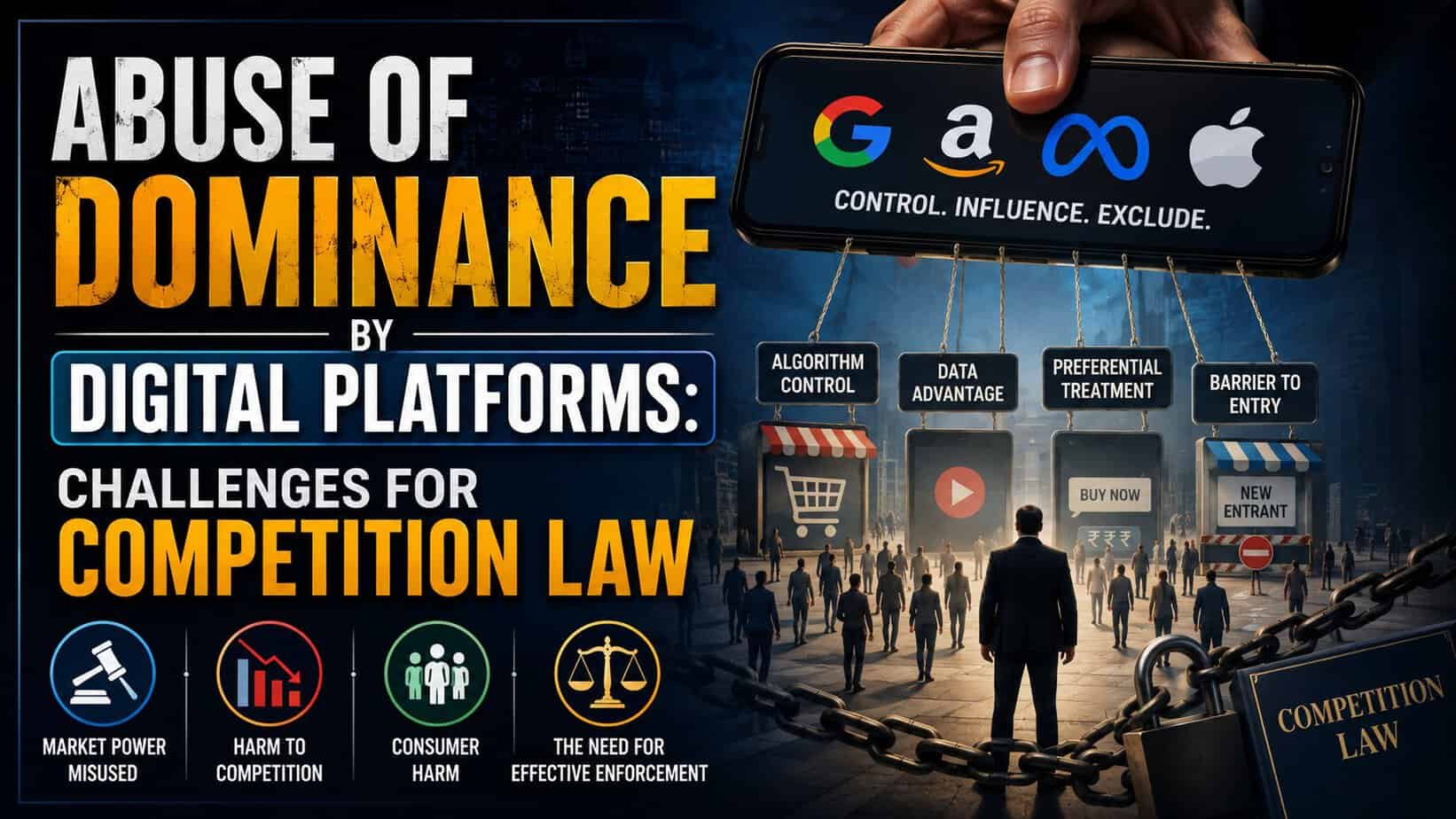
Unlike traditional companies that only sell products, big digital companies control entire ecosystem. They own the marketplaces, set the rules, and compete against the independent sellers using their own platforms. This leads to anti-competitive practices like:
- Self-Preferencing: A platform changes its algorithm to show its own products first, at the very top of the page, hiding better or cheaper options from others.
- Tying and Bundling: platforms force consumers or manufacturers to accept secondary products to get access to their main service. For example, a company might force phone manufacturers to install its specific browser to get access to its mainstream app store.
- Killer Acquisitions: Dominant companies buy up small, innovative startups before they can become real competitors. This stops new ideas from ever competing the giants.
- Data Hoarding: Big platforms extract massive amounts of user data. More data leads to better algorithms, which attracts more users, who then generate even more data. This makes it almost impossible for smaller companies to compete.
The Core Challenges Facing Competition Law
Why aren’t current laws enough to stop this?
Traditional antitrust laws, like the Sherman Act in the US or Section 4 of India’s Competition Act, were made for physical businesses. They don’t work well for the digital world for several reasons:
| Challenges | Traditional Market | Digital Platform Market |
| Defining the Market | Clear geographic boundaries and straightforward product categories (e.g., steel manufacturing). | Multi-sided ecosystems where platforms serve users, advertisers, and sellers simultaneously. |
| The concept of “Price” | Predatory pricing is measured by selling goods below the cost of production to drive out competitors. | Basic services cost nothing. Platforms make money by extracting data and selling ads, making traditional price-testing useless. |
| Regulatory Speed | Antitrust lawsuits can last for years, but traditional markets change slowly enough to wait for them. | Technology changes very fast. By the time an investigation concludes (usually 5 to 7 years), the harmed competitor has already bankrupted. |
The Ineffectiveness of the Price Test
For years, regulators used the SSNIP (Small but Significant and Non-Transitory Increase in Price) Test to look for monopolies. This test looked at whether a company could raise prices by 5% without losing customers.
However, this doesn’t work for companies like Google, Instagram or WhatsApp, where services are free. Now, regulators are trying the SSNDQ (Small but Significant and Non-Transitory Decrease in Quality or Privacy) Test, which looks at small decreases in quality or privacy instead. But it is very hard to prove in court exactly how much a loss of privacy or a change in algorithms is worth.
Shifting from Cure to Prevention: Ex-Ante Regulation
Because retroactive lawsuits take too long, global regulators are shifting from ex-post enforcement i.e., punishing abuse after it happens to ex-ante regulation i.e., setting rules that prevent it from happening in the first place.
We are seeing a wave of strict legislations: In the EU, the Digital Markets Act forces big tech platforms to operate with competitors and stops self-preferencing. In US, government agencies are actively trying to break up dominant companies through legal trials.
In India, a proposed digital competition bill is designed to curb anti-competitive practices through significant digital intermediaries.
Conclusion
The main objective of modern competition law is not to punish successful tech companies. Innovations should always be awarded. However, a market is no longer free when a few giant platforms use algorithms to control everything people see and buy, while also crushing small startups that might compete with them. Updating these laws for the digital age is not just a legal debate; it is necessary to make sure the next generation of innovators has a fair chance to compete and succeed.
References
- Abuse_of_Dominant_Position_in_Digital_Markets
- Abuse of Dominance — Global Enforcement Guide | KSK Competition Law | KSK Competition Law
- Digital Dominance and Social Media Platforms: Are Competition Authorities Up to the Task? – PMC
- Full article: Effective remedies in digital market abuse of dominance cases
- Competition Law in Digital Markets: Abuse of Dominance by Digital Platforms – LawArticle
- Enforcing competition law in digital markets and ecosystems: Policy challenges and options