Authored By: Kimaya Joshi (B.B.A.LL.B (Hons)), NMIMS Hyderabad, Research Writer at Law Audience,
Edited By: Mr. Varun Kumar, Advocate, Himachal, Punjab & Haryana and Founder at Law Audience
Introduction
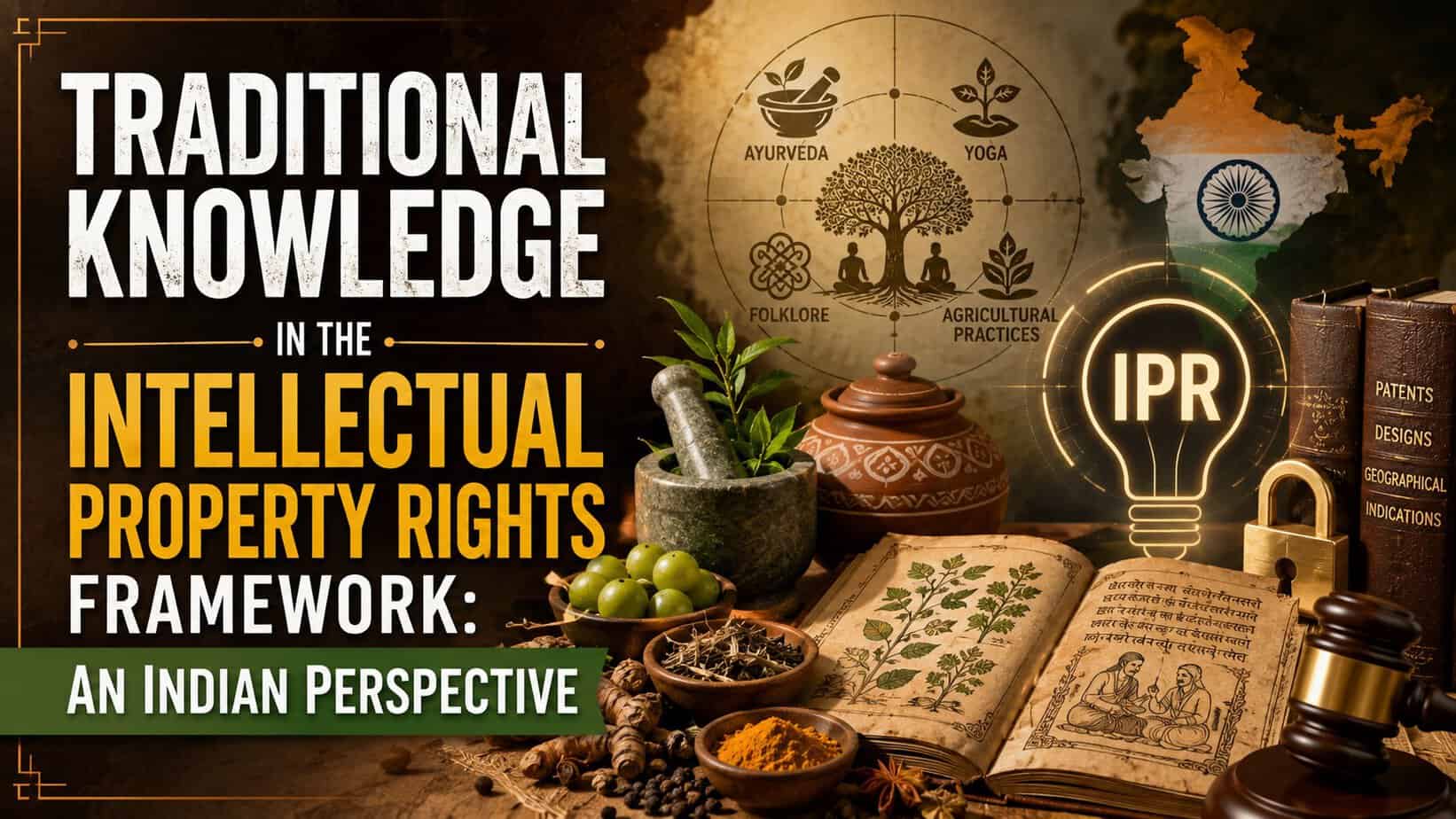
Traditional knowledge (TK) is knowledge, know-how, skills and practices that are developed, sustained and passed on from generation to generation within a community, often forming part of its cultural or spiritual identity.[1] Hence, one can say that traditional knowledge is a term that refers to knowledge, practices and innovations of local and indigenous communities that have been passed down from generations around the world. These practices have been developed from experience gained over centuries while adapting to the local culture and environment and transmitted orally from generation to generation.[2]
Rights over traditional knowledge are collective rights owned by the community in forms of songs, folklore, local language, agricultural practices, beliefs, cultural values, etc. Today we can see that there is a growing appreciation of the value of traditional knowledge. This knowledge is now valuable to not only those who depend on it for their survival and daily life but also the modern industry and agriculture. At present many health products, cosmetics and widely used plant-based medicines have been the result of traditional knowledge.
Traditional knowledge also has a significant potential of contributing to sustainable development. This is because practices of most local and indigenous communities across the world are sustainable. They have used Earth’s biodiversity and genetic resources in a sustainable manner for thousands of years across generations.
Criteria to qualify as Traditional Knowledge
There is not an exhaustive set of criteria that is there to check whether some knowledge or practice qualifies as Traditional Knowledge. With a general observation of the trend across the world, this can be said to form fundamental basis of traditional knowledge:
- Construction of a new practice / process for fulfilling a need.
- Transmission of the process/ method through generations by the virtue of customs.
- Restricted to the group / community within a particular group / community by virtue of its values.[3]
Traditional knowledge and IP
Innovations that are based on Traditional Knowledge can get benefit from may IP protections like Patent, Trademark, GI or Trade Secret. But the Traditional Knowledge that is oral is not protected by conventional IP systems. There are two broad policy issues that govern IP in Traditional Knowledge:
- Defensive Protection: It is a set of strategies to ensure that third parties do not gain illegitimate or unfounded IP rights over TK. These measures include amendment of WIPO-administered patent systems like the Patent Cooperation Treaty Minimum Documentation.[4] Some countries have also come forward to developing TK databases[5]which would serve as evidence of prior art in order to defeat the claim to a patent on such TK.[6]
- Positive Protection: There are two aspects of positive protection of TK with respect to IP rights that are –
Preventing unauthorized use, and
Active exploitation of TK by the originating community itself.[7]
India’s Perspective on Traditional Knowledge
India is home to wealth of knowledge acquired by indigenous tribes and people passed down through generations forming the identity of such community. India is a land of diverse cultures with a vast repository of Traditional Knowledge since ancient times. India however does not have a specific legislation dealing with Traditional Knowledge and Traditional Cultural Expressions. There are bits and pieces of protection provided through some provisions scattered across various legislations like the Patent Act, 1970, Plant Variety Protection and Farmers Rights Act, 2001, Biological Diversity Act, 2002, The Geographical Indications of Goods (Registration and Protection) Act, 1999, etc.
When there is a question as to why it is needed to protect Traditional Knowledge, it is to avoid its commercial exploitation and depriving the actual bearers of the Knowledge of the well-deserved benefits. Around 2500 and 500 BC India developed a lot of concepts such as Ayurveda, Siddha, and Unani and reserved the spot of the largest provider of such traditional medicinal systems as well as medicinal plants.[8] There have been numerous instances when firms have been granted patents for India’s legacy and India had to fight these patents.
One of such examples is Neem Tree Biopiracy Case. Neem has been used in India as a bio-insecticide and medicine for ages. In 1994 the European Patent Office granted European Patent No. 0436257 to the US Corporation W.R. Grace and USDA for a “method for controlling fungi on plants by the aid of hydrophobic extracted neem oil”[9]. The patent was revoked in 2000 on the ground that ‘neem’ has been used in India for centuries.[10][11]
An initiative taken by India, known as the Traditional Knowledge Digital Library (TKDL), is established through collaboration of the Council of Scientific and Industrial Research (CSIR) and the Ministry of Ayush. This initiative aims at protecting Indian traditional medicine knowledge from being misappropriated at the Patent Offices around the world. The TKDL contains information on rich traditional knowledge of drugs and medicines provided in classical or traditional texts relating to Ayurvedic, Unani, Siddha, Sowa Rigpa systems of medicines and Yoga.
The contents of ancient texts about medicine and health, which were available in the local languages of India like, Sanskrit, Hindi, Arabic, Persian, Urdu, Tamil, Bhoti, etc., are converted into digital form in five foreign languages, such as English, French, German, Spanish and Japanese in the TKDL database.
In accordance with the current Government of India approvals, the patent offices of various countries that have signed a non-disclosure agreement with the CSIR can access the database. There are 14 patent offices that have been given access to the TKDL database, including the Indian Patent Office (Controller General of Patents, Designs & Trade Marks), the European Patent Office, the US Patent Office, the Japanese Patent Office, the German Patent Office, the Canadian Patent Office, the Chilean Patent Office, the Australian Patent Office, the UK Patent Office, the Malaysian Patent Office, the Russian Patent Office, the Peruvian Patent Office, the Spanish Office of Patents and Trademark, the Danish Office of Patents and Trademark.
The CSIR-TKDL Unit has been filing third party observations and pre-grant oppositions on patent applications concerning Indian traditional knowledge using TKDL. India is the only country in the world that has obtained an institutional setup for safeguarding its traditional knowledge (TKDL).
With the aid of TKDL, it is possible to cancel or withdraw patent requests related to Indian TK almost without any delay. TKDL has already enabled the cancellation or withdrawal of many patent requests declaring the right to utilize a wide range of therapeutic plants. In India, TKDL is a unique tool for the protection of the country’s traditional knowledge.
Footnotes:
[1] Traditional Knowledge, traditional-knowledge, https://www.wipo.int/en/web/traditional-knowledge/tk/index (last visited July 11, 2026).
[2] Biosafety Unit, Introduction, (Oct. 19, 2021), https://www.cbd.int/traditional/intro.shtml.
[3] Riya, Protection of Traditional Knowledge under Intellectual Property Rights Regime, 1 E-Journal of Academic Innovation and Research in Intellectual Property Assets (E-JAIRIPA) 133 (2020).
[4] Document Details, https://www.wipo.int/meetings/en/doc_details.jsp?doc_id=37709 (last visited July 11, 2026).
[5] Online Databases and Registries of Traditional Knowledge and Genetic Resources, traditional-knowledge, https://www.wipo.int/en/web/traditional-knowledge/resources/db_registry (last visited July 11, 2026).
[6] Manuel Ruiz, THE INTERNATIONAL DEBATE ON TRADITIONAL KNOWLEDGE AS PRIOR ART IN THE PATENT SYSTEM: ISSUES AND OPTIONS FOR DEVELOPING COUNTRIES.
[7] Traditional Knowledge, supra note 1.
[8] M. M. Pandey, Subha Rastogi & A. K. S. Rawat, Indian Traditional Ayurvedic System of Medicine and Nutritional Supplementation, 2013 Evid Based Complement Alternat Med 376327 (2013).
[9] Neem Oil – an Overview | ScienceDirect Topics, https://www.sciencedirect.com/topics/pharmacology-toxicology-and-pharmaceutical-science/neem-oil (last visited July 11, 2026).
[10] supra note 3; Online Databases and Registries of Traditional Knowledge and Genetic Resources, supra note 5.
[11] DOCUMENTING TRADITIONAL KNOWLEDGE 2: Chapter 1 – The Legacy of Oral Cultures, Studocu, https://www.studocu.com/in/document/vellore-institute-of-technology-ap-university/essence-of-indian-traditional-knowledge/documenting-traditional-knowledge-2-chapter-1-the-legacy-of-oral-cultures/160820151 (last visited July 11, 2026).