
Click here to download the full paper (PDF)
Authored By: Vinita Rai, & Co-Authored By: Dr. Rajendra Mishra, Assistant Professor, ABS, Amity University Lucknow Campus, Uttar Pradesh, India,
Click here for Copyright Policy.
ABSTRACT:
“Employee job satisfaction plays an important role in improving productivity and organizational performance. This research paper examines the level of job satisfaction among employees and identifies the major factors influencing their satisfaction. The study was conducted using a structured questionnaire distributed to 100 employees. The data collected were analysed using percentage and graphical methods. The results indicate that work environment, salary, management support, and career growth opportunities significantly influence employee satisfaction. The study concludes that organizations should focus on improving workplace conditions and employee motivation to enhance job satisfaction”.
Keywords: Employee Satisfaction, Work Environment, Motivation, Human Resource Management.
I. INTRODUCTION:
Employee job satisfaction refers to the level of contentment employees feel regarding their job roles, responsibilities, and workplace environment. It is an important factor for organizational success because satisfied employees tend to be more productive, loyal, and motivated. In today’s competitive business environment, organizations are focusing on improving employee satisfaction to maintain productivity and reduce employee turnover. Factors such as salary, working conditions, management behaviour, and career growth opportunities have a significant impact on employee satisfaction. This research aims to study the level of job satisfaction among employees and identify the key factors that influence their satisfaction at work.
II. LITERATURE REVIEW:
Several researchers have studied employee job satisfaction and its impact on organizational performance. Job satisfaction is considered an important factor that influences employee productivity, motivation, and organizational commitment. Researchers have found that satisfied employees tend to be more loyal to their organizations and are less likely to leave their jobs. According to Edwin A. Locke (1976), job satisfaction is a positive emotional state resulting from the appraisal of one’s job or job experiences. Locke emphasized that employees develop satisfaction when their job meets their expectations, values, and personal goals. If the job environment provides opportunities for growth, recognition, and achievement, employees are more likely to feel satisfied with their work. Similarly, Frederick Herzberg (1959) proposed the Two-Factor Theory, which explains the factors affecting job satisfaction and dissatisfaction. According to Herzberg, motivational factors such as achievement, recognition, responsibility, and opportunities for advancement lead to higher job satisfaction. On the other hand, hygiene factors such as salary, company policies, working conditions, and job security help prevent dissatisfaction but may not necessarily increase satisfaction. Many studies also highlight the importance of workplace environment and management support in improving employee satisfaction. A positive work environment encourages employees to perform better and increases their engagement with organizational goals. When employees feel valued and respected by their supervisors, they develop a stronger commitment toward the organization.
III. RESEARCH METHODOLOGY RESEARCH:
Design: Descriptive research Sample Size: 100 employees
Data Collection Method: Questionnaire survey Sources of Data:
Primary data: Questionnaire responses
Secondary data: Books, journals, and online articles
IV. DATA ANALYSIS & INTERPRETATION:
Based on the responses collected from 100 employees:
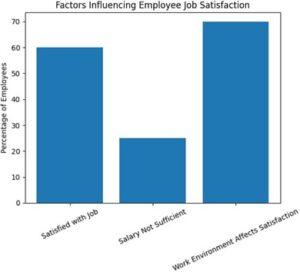
60% of employees are satisfied with their job. 25% of employees feel salary is not sufficient.
70% of employees believe that work environment affects their satisfaction.
These results show that job satisfaction depends on several factors such as salary, work environment, and management support. The bar chart shows the factors affecting job satisfaction. 60% of employees are satisfied with their job, 25% feel their salary is not sufficient, and 70% believe that the work environment affects their satisfaction. This shows that salary and work environment play an important role in employee satisfaction.
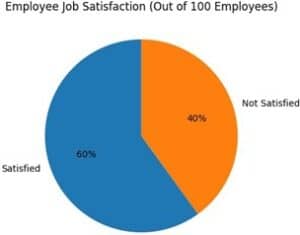
The pie chart shows that 60% of employees are satisfied with their job, while 40% are not satisfied. This indicates that most employees feel positive about their job, but some improvements are still needed to increase satisfaction.
V. FINDINGS / RESULTS:
The study revealed the following findings:
Most employees are satisfied with their job roles.
Work environment plays a major role in employee satisfaction.
Salary and promotion opportunities significantly affect employee motivation.
VI. RECOMMENDATIONS:
Based on the findings, the following suggestions are recommended: Organizations should improve employee compensation policies. Management should create a positive work environment. Employee training and development programs should be conducted regularly.
VII. CONCLUSION:
Employee job satisfaction is an important factor for organizational success. Satisfied employees are more motivated, productive, and committed to their work, which helps organizations achieve their goals effectively. When employees feel valued and supported by their organization, they tend to perform better and contribute positively to the overall growth of the company. The study concludes that organizations must focus on improving the work environment, salary structure, and employee motivation programs to enhance job satisfaction. A positive and supportive work environment encourages employees to perform their tasks efficiently and increases their engagement with organizational objectives. Similarly, fair salary and benefits play a significant role in motivating employees and maintaining their loyalty toward the organization. In addition, organizations should also provide opportunities for training, development, and career growth to keep employees motivated and satisfied with their jobs. By focusing on these factors, companies can improve employee satisfaction, reduce employee turnover, and ultimately increase overall productivity and organizational performance.
Cite this article as:
Vinita Rai & Dr. Rajendra Mishra, “Employee Job Satisfaction”, Vol.6 & Issue 3, Law Audience Journal (e-ISSN: 2581-6705), Pages 355 to 359 (10th March 2026), available at https://www.lawaudience.com/employee-job-satisfaction/.
Reference:
- Edwin Locke (1976). Nature and Causes of Job Satisfaction. In M. D. Dunnett (Ed.), Handbook of Industrial and Organizational Psychology. Chicago: Rand McNally.
- This work explains the concept of job satisfaction and the factors that influence employees’ attitudes toward their
- Frederick Herzberg (1959). The Motivation to New York: John Wiley & Sons. This book introduces the Two-Factor Theory, explaining how motivational and hygiene factors affect employee satisfaction and dissatisfaction in the workplace.