Click here to download the full paper (PDF)
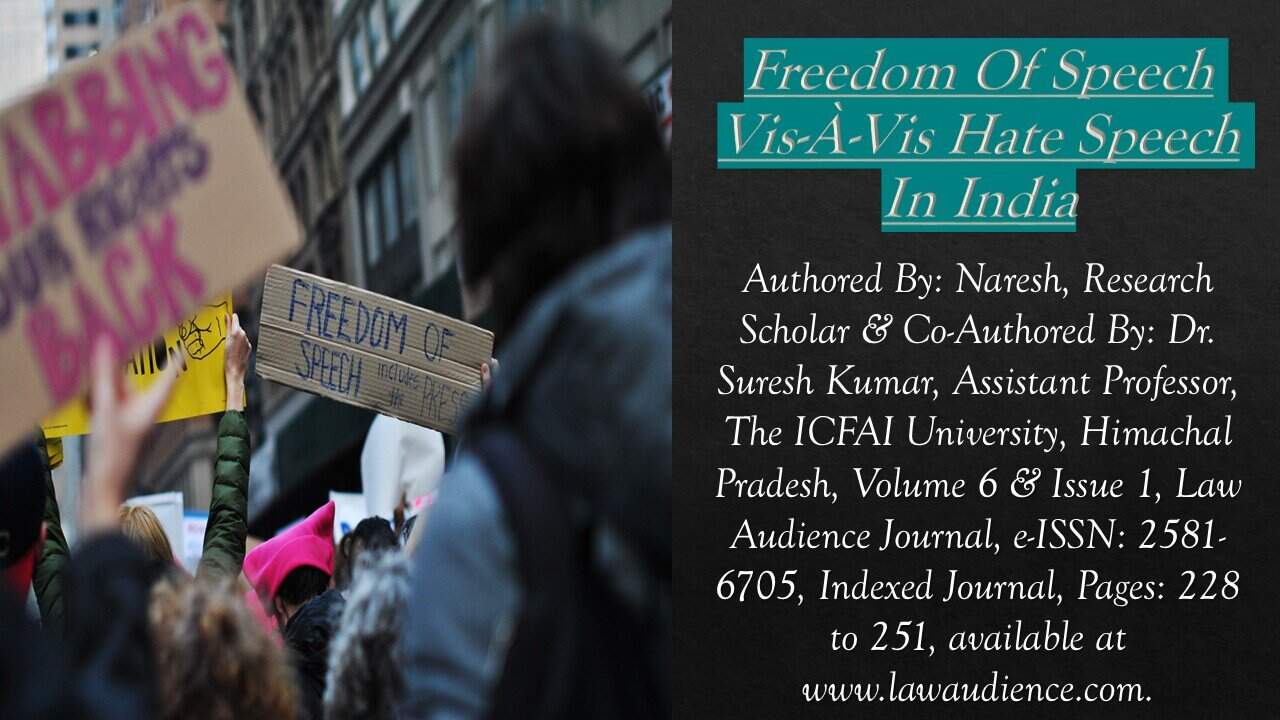
Authored By: Naresh, Research Scholar & Co-Authored By: Dr. Suresh Kumar, Assistant Professor, The ICFAI University, Himachal Pradesh,
Click here for Copyright Policy.
ABSTRACT:
“The right to freedom of speech and expression, as established by Article 19(1)(a) of the Indian Constitution, serves as a fundamental element of the nation’s democratic structure. Nevertheless, this right is not without limitations and is subject to reasonable constraints as outlined in Article 19(2) to protect various interests, including public order, morality, and state sovereignty. In recent times, the increase in hate speech—especially through political discourse and online platforms—has sparked renewed discussions regarding the appropriate boundaries of free speech within a diverse society such as India. This research paper aims to investigate the intricate relationship between the right to free speech and the government’s responsibility to regulate hate speech. The main goal is to analyze how Indian constitutional law, statutory regulations, and judicial rulings strive to reconcile individual freedoms with societal cohesion. The paper employs a doctrinal approach, scrutinizing constitutional provisions, pertinent sections of the Indian Penal Code, and significant judgments from the Supreme Court and High Courts. Additionally, it incorporates comparative perspectives from legal systems in the United States, Germany, and South Africa. The findings of the study indicate that the lack of a clear legal definition of hate speech in India, along with varying judicial interpretations, has led to both insufficient enforcement and potential misuse of the law. The paper concludes by advocating for a rights-based, contextually aware legal framework that upholds freedom of expression while effectively addressing hate speech”.
I. INTRODUCTION:
Freedom of speech is essential to a democratic society. It acts as a cornerstone for individual liberty, civic engagement, and the ongoing development of societal values. Democracies worldwide cherish this right not only as a civil freedom but also as a prerequisite for substantial dialogue, dissent, and discussion. However, this right is not absolute and can be subject to conflict. When expressions result in harm, provoke violence, or disrupt public peace, it becomes necessary to regulate speech while maintaining its core principles. The contemporary challenge is to establish a fair boundary between protected speech and prohibited incitement.[1] In India, the right to free speech is enshrined in the Constitution under Article 19(1)(a), which grants citizens the right to freedom of speech and expression. Nevertheless, Article 19(2) empowers the state to impose reasonable limitations on this right for the sake of sovereignty, security, public order, decency, morality, and other considerations. This meticulously designed equilibrium aims to preserve liberty without jeopardizing the nation’s unity and integrity. Over the years, Indian courts have been instrumental in interpreting these provisions and protecting against both censorship and social harm.[2] Recently, India has experienced a concerning increase in hate speech—both offline and online—especially concerning religion, caste, politics, and gender. Hate speech has thrived in electoral discourse, social media misinformation, and divisive news reporting. Incidents such as the Delhi riots (2020) and the Karnataka Hijab Controversy (2022)[3] illustrate how unchecked speech can lead to actual violence and exacerbate societal rifts. At the same time, there is rising apprehension that laws ostensibly aimed at combating hate speech are being misapplied to stifle dissent and criminalize criticism, raising concerns about the erosion of free speech.[4]
This paper aims to conduct a critical examination of the intricate relationship between freedom of speech and the regulation of hate speech in India. The primary research questions are as follows:
- How has the Indian legal framework interpreted and reconciled the right to free speech with the necessity to restrict hate speech?
- What institutional and legal deficiencies exist in the current handling of hate speech in India?
- What insights can be gleaned from international frameworks to enhance India’s strategy?
The methodology employed is predominantly doctrinal, drawing upon constitutional provisions, judicial precedents, reports from the Law Commission, and secondary literature. An analysis of case law is integral to the study, facilitating an understanding of how courts have delineated between speech that is protected and that which is prohibited. A comparative perspective is also utilized to investigate how other democratic nations have confronted analogous issues. By exploring these matters, this research aspires to enrich the ongoing dialogue regarding how India can more effectively fulfill its constitutional commitments to both liberty and equality in the context of speech.
II. CONSTITUTIONAL AND LEGAL FRAMEWORK:
The Constitution of India places significant emphasis on the right to freedom of speech and expression, viewing it as a fundamental component of its democratic structure. Nonetheless, this right is subject to restrictions that are constitutionally sanctioned, particularly for the purpose of maintaining public order and safeguarding the rights of others. [5]The Indian legal framework, through constitutional provisions and penal laws, strives to achieve a careful equilibrium between the protection of free expression and the limitation of hate speech. This section delves into the constitutional parameters of free speech as outlined in Article 19(1)(a), the constraints established by Article 19(2), and the pertinent penal regulations aimed at governing hate speech in India.
II.I ARTICLE 19(1)(A): SCOPE AND JUDICIAL INTERPRETATION:
Article 19(1)(a) of the Constitution guarantees every citizen the right to “freedom of speech and expression.” This encompasses the liberty to convey one’s thoughts freely through spoken or written communication, images, or any other form of expression. The Indian judiciary has consistently underscored the importance of this right as central to democratic governance. In the landmark case of Romesh Thappar v. State of Madras (1950), the Supreme Court asserted that freedom of speech is foundational to all democratic institutions, and without the ability to engage in free political discourse, neither public education nor political transformation can occur. The interpretation of Article 19(1)(a) has evolved to encompass a broad range of expressions. It not only includes the right to share ideas and opinions but also the right to access information. In the case of Indian Express Newspapers v. Union of India (1985), the Supreme Court acknowledged that the freedom of the press is inherently included within Article 19(1)(a). Likewise, the rights to commercial speech, artistic expression, and academic freedom have also been recognized as falling under its scope. However, this right is not without limitations. The Constitution imposes certain permissible restrictions on this freedom through Article 19(2).
II.II ARTICLE 19(2): GROUNDS FOR REASONABLE RESTRICTIONS:
Article 19(2) allows the State to impose “reasonable restrictions” on the exercise of the right to freedom of speech and expression for the following reasons:
- Sovereignty and integrity of India
- Security of the State
- Friendly relations with foreign States
- Public order
- Decency or morality
- Contempt of court
- Defamation
- Incitement to an offence
These restrictions aim to prevent the misuse of free speech in ways that could jeopardize social harmony or national security. The term “reasonable” suggests a standard that is subject to judicial review to ensure that restrictions are neither arbitrary nor excessive. In S. Rangarajan v. P. Jagjivan Ram (1989), the Supreme Court emphasized that “freedom of expression cannot be curtailed due to the threat of demonstrations and processions or threats of violence,” and any restriction must be grounded in a genuine and immediate threat to public order.
II.III RELEVANT PENAL PROVISIONS ADDRESSING HATE SPEECH:
While the Constitution establishes the framework, the Indian Penal Code (IPC) and other statutory laws implement restrictions on speech, particularly concerning hate speech.
Section 196 BNS: Promoting Enmity Between Groups
This section criminalizes speech that incites enmity between various groups based on religion, race, place of birth, residence, language, etc., and actions detrimental to the maintenance of harmony. It encompasses spoken or written words, signs, visible representations, or any act that provokes hatred or violence among groups.[6]
Section 299 BNS: Deliberate Acts Intended to Outrage Religious Feelings
Section 295A addresses intentional and malicious acts aimed at insulting the religious beliefs of any group. It is often invoked in cases involving religious satire, artistic expression, and public speeches considered blasphemous by certain groups.
Section 353 BNS: Statements Conducing to Public Mischief
This section imposes penalties on the dissemination or distribution of statements or reports that could provoke violence, instigate panic, or foster hostility among various communities. Subsections such as 505(1)(b) and 505(2) are particularly pertinent to cases involving hate speech.
Section 66A of the IT Act (Struck Down)
Section 66A of the Information Technology Act, 2000, formerly criminalized the transmission of offensive messages via communication services. Nevertheless, in the case of Shreya Singhal vs. Union of India (2015), the Supreme Court declared the section unconstitutional due to its vagueness and excessive breadth, which disproportionately restricted free speech. [7]This ruling represented a pivotal development in the realm of digital speech law in India, although the challenge of regulating online hate speech continues to be a contentious issue.
II.IV LEGAL AMBIGUITY IN DEFINING “HATE SPEECH”:
A significant obstacle in the regulation of hate speech in India is the lack of a precise, statutory definition of the term. In contrast to nations like Germany or Canada, Indian legislation does not explicitly define “hate speech,” resulting in ambiguity regarding enforcement and interpretation.[8] Consequently, law enforcement and lower courts frequently apply the IPC provisions inconsistently, at times merging offensive or unpopular speech with genuine incitement to hatred or violence. The Law Commission of India, in its 267th Report (2017), acknowledged this ambiguity and suggested the introduction of new provisions specifically aimed at addressing hate speech.[9] The report recommended that hate speech be defined by the intent to incite violence or foster discrimination, rather than solely on the grounds of offense or hurt sentiments.
Judicial decisions have reflected this concern. In the case of Pravasi Bhalai Sangathan vs. Union of India (2014), the Supreme Court recognized the issue of hate speech and urged Parliament to contemplate the enactment of legislation to regulate it effectively. Nevertheless, the Court also highlighted the significance of free speech in a democratic society and the potential for misuse of such laws to suppress dissent. Moreover, the absence of definitional clarity often results in the selective enforcement of these laws. Critics contend that authorities tend to ignore hate speech from influential figures while promptly acting against dissenters or marginalized groups. This inconsistency undermines the credibility of legal safeguards against hate speech and contributes to a chilling effect on free expression.
III. JUDICIAL APPROACH TO HATE SPEECH:
The Indian judiciary has been instrumental in defining the parameters of freedom of speech and its allowable restrictions. In the absence of a legal definition for “hate speech” within Indian legislation, courts have had to interpret constitutional clauses and criminal laws to confront the issues arising from inflammatory, inciting, or derogatory remarks. This section examines pivotal judicial rulings that have shaped India’s legal framework regarding hate speech and assesses the judiciary’s efforts to strike a balance between individual liberty and societal order.
Romesh Thappar vs. State of Madras:
As one of the earliest and most consequential rulings concerning free speech in post-independence India, Romesh Thappar vs. State of Madras[10], (AIR 1950 SC 124), established a foundation for the interpretation of Article 19(1)(a). The case involved the prohibition of leftist publication under the Madras Maintenance of Public Order Act, 1949, on the basis that it disrupted public order. The Supreme Court determined that the freedom of speech and expression is vital for the effective operation of democracy and that any limitations on this freedom must be interpreted restrictively. Notably, the Court annulled the restriction, emphasizing that at that time (prior to the First Amendment), “public order” was not explicitly enumerated as a justification under Article 19(2). This ruling illustrated the Court’s dedication to protecting speech unless there was a clear and present danger to state security or public tranquility.
This case, alongside Brij Bhushan, played a significant role in prompting the First Constitutional Amendment in 1951, which added “public order” to Article 19(2).
Brij Bhushan vs. State of Delhi:
In Brij Bhushan vs. State of Delhi (AIR 1950 SC 129), the Court evaluated the constitutionality of pre-censorship imposed on the publication of the newspaper, Organizer, linked to the RSS. The state contended that this action was necessary to avert communal discord. The Supreme Court declared pre-censorship unconstitutional, highlighting that such limitations were not warranted under Article 19(2) as it was at that time. The Court reaffirmed that freedom of expression cannot be restricted without a clear constitutional basis. Both Thappar and Brij Bhushan highlighted the judiciary’s hesitance to permit pre-emptive state intervention in free speech, thereby establishing a robust liberal precedent that safeguarded expression unless a distinct and immediate threat was present.[11]
Rangarajan vs. P. Jagjivan Ram:
This pivotal case reaffirmed the stringent criteria for restricting speech. S. Rangarajan vs. P. Jagjivan Ram (1989) involved the Tamil film “Ore Oru Gramathile,” which critiqued the caste-based reservation system. Although the film received certification from the Censor Board, it was subsequently withdrawn in response to political protests. The Supreme Court determined that freedom of expression cannot be curtailed unless there exists a direct and tangible threat to public order. The Court famously articulated:
“Freedom of expression cannot be held to ransom by an intolerant group of people. The anticipated danger should not be remote, conjectural, or far-fetched.”
This case is often referenced to uphold the principle that expression cannot be limited solely because it might offend or disturb particular segments of society. The ruling underscores that considerations of public order must be based on actual circumstances rather than mere speculation or subjective discontent.[12]
Pravasi Bhalai Sangathan vs. Union of India:
In the case of Pravasi Bhalai Sangathan vs. Union of India (AIR 2014 SC 1591), the Supreme Court considered a petition that sought more stringent legal measures against hate speech perpetrated by public figures. The petition underscored the rising occurrences of communal and caste-related remarks made by politicians. The Court recognized the gravity of hate speech and the insufficiency of current legal remedies; however, it chose not to issue new guidelines, referencing the doctrine of separation of powers. Instead, the Court deferred the issue to the legislature, encouraging Parliament to deliberate on the establishment of a clear and effective framework to govern hate speech. This ruling illustrates judicial restraint in legislating from the bench while concurrently acknowledging the pressing need for legal clarity. It also pointed out that existing provisions such as Sections 153A, 295A, and 505 IPC were inadequate due to their broad interpretation and inconsistent enforcement.[13]
Ameena Begum vs. State of Andhra Pradesh:
In the High Court case of Ameena Begum vs. State of Andhra Pradesh (2022), the petitioner contested the police’s inaction regarding the prosecution of hate speeches delivered during political rallies. The Court acknowledged the increasing prevalence of divisive and inflammatory rhetoric by public officials and observed that selective enforcement eroded public trust in the rule of law. Although the court did not establish new legal doctrines, it instructed authorities to take swift action against hate speech without political favoritism. This ruling reflected an escalating judicial concern regarding the state’s failure to act impartially and underscored the judiciary’s role in promoting administrative accountability.[14]
IV. JUDICIAL ATTEMPTS TO DEFINE HATE SPEECH:
Despite numerous opportunities, Indian courts have predominantly avoided providing a definitive, universally recognized definition of “hate speech.” Rather, they have tackled the matter on an individual case basis. The Supreme Court has occasionally associated hate speech with expressions that:
- Incite violence or discrimination.
- Foster animosity between groups;
- Maliciously offend religious sentiments.
Nevertheless, this contextual approach has resulted in inconsistencies. For instance, what is deemed “offensive” or “malicious” can differ greatly across various rulings, resulting in legal ambiguity. The Law Commission’s 267th Report (2017) suggested that hate speech should be defined according to intent and impact, such as incitement to discrimination, hostility, or violence. However, in the absence of codified statutory language, courts frequently find themselves interpreting vague terms within the IPC, which risks both overreach and insufficient enforcement.[15]
V. CHILLING EFFECT AND PROBLEMS OF ENFORCEMENT:
A persistent issue in judicial discussions is the “chilling effect” — a phenomenon where individuals refrain from expressing legitimate opinions due to the fear of prosecution or harassment. This issue has been particularly pronounced in cases involving artists, journalists, comedians, and political dissenters. A notable illustration of this is the Shreya Singhal vs. Union of India (2015) case, in which the Supreme Court invalidated Section 66A of the IT Act. The Court determined that ambiguous and subjective terms such as “grossly offensive” or “menacing” were prone to misuse and had a chilling effect on free speech. The ruling emphasized that any limitations on speech must be clear, narrowly defined, and proportionate to the harm intended to be mitigated.[16] Notwithstanding this, numerous state authorities persist in applying Sections 196, 299, and 353 of the BNS against individuals whose expressions may be deemed unpopular or politically inconvenient, rather than those that truly incite hatred. In contrast, authentically hateful discourse, particularly from individuals with political connections, frequently escapes punishment due to selective enforcement or a lack of administrative action. This biased methodology undermines the credibility of hate speech regulations, diminishes public trust in law enforcement, and leads to judicial interventions that are often either tardy or insufficient in their scope.
VI. HATE SPEECH IN PRACTICE: SOCIAL MEDIA, POLITICS, AND RELIGION:
Despite the constitutional protections for free speech in India, hate speech has gained considerable traction in everyday conversations. Driven by digital platforms, communal political agendas, and gaps in systemic enforcement, hate speech increasingly influences public narratives and often leads to tangible harm. This section examines the dynamics of hate speech in India, emphasizing its proliferation through social media, its impact on politics, significant incidents, and the effectiveness of governmental responses.
VII. HATE SPEECH ON SOCIAL MEDIA PLATFORMS:
Social media has transformed communication, yet it has also emerged as a potent channel for hate speech. Platforms such as Facebook, Twitter (now X), WhatsApp, and YouTube frequently amplify provocative content due to algorithms that favor engagement over ethical considerations. [17]Posts that incite hatred, target minority groups, or elicit outrage tend to garner more attention, thus enhancing their visibility. An internal leak from Facebook in 2021 disclosed that its operations in India often overlooked hate speech directed at Muslims, as such content received high engagement and was seldom moderated adequately. Likewise, WhatsApp, with its encrypted framework and extensive usage, has served as a major conduit for the swift dissemination of hate-filled content—often untraceable due to forwarding chains and a lack of accountability.[18] The issue is exacerbated by low digital literacy, which renders users more vulnerable to accepting inflammatory or misleading content as factual.
VIII. THE IMPACT OF FAKE NEWS AND MISINFORMATION:
Fake news and misinformation play a pivotal role in the spread of hate speech within India. Fabricated or misleading narratives frequently target specific religious or caste groups, instigating fear and animosity. A notable instance occurred during the COVID-19 pandemic, following the Tablighi Jamaat event in Delhi, where a multitude of false videos and news articles branded Muslims as “super-spreaders,” exacerbating Islamophobia nationwide.[19] Manipulated videos, which falsely portray Muslims engaging in acts such as spitting on food or assaulting Hindus, tend to circulate extensively on social media platforms, occasionally even disseminated by verified accounts with large followings. Such narratives intensify communal tensions, perpetuate stereotypes, and, in severe instances, provoke violence. In spite of numerous alerts and certain moderation strategies, prominent social media platforms have faced challenges in effectively eliminating this type of content, particularly in regional languages where hate speech is frequently most aggressive.
IX. THE ROLE OF COMMUNAL POLITICS AND RHETORIC DURING ELECTIONS:
The political landscape in India has increasingly been marred by hate speech, particularly in the context of elections. Leaders from various political parties have resorted to divisive rhetoric to polarize the electorate along religious or caste lines. Provocative statements such as “desh ke gaddaron ko, goli maaro” (shoot the traitors), which were voiced during the Delhi Assembly elections in 2020, illustrate the normalization of violent discourse within political campaigns. Discourse surrounding topics like “Love Jihad,” “Ghar Wapsi,” and cow protection often functions as mechanisms to galvanize majoritarian sentiments, thereby marginalizing minority groups. Political figures sometimes depict Muslims or Dalits as threats to cultural or national cohesion, embedding hatred into mainstream narratives.[20] Although the Election Commission of India sporadically issues warnings or imposes bans on politicians’ campaigning activities, these measures are frequently symbolic and short-lived. Accountability remains a distant goal, as many public figures continue to act without facing consequences.[21]
X. KEY HATE SPEECH-RELATED INCIDENTS:
Several recent occurrences underscore the connection between hate speech and communal discord.
Delhi Riots (2020):
The riots in Delhi during February 2020 were preceded by weeks of incendiary speeches amid anti-CAA protests. The address by BJP leader Kapil Mishra, which called for police action against the demonstrators, was widely regarded as a catalyst. This was followed by communal violence that resulted in the deaths of over 50 individuals, predominantly from the Muslim community. Investigations and fact-finding reports indicated a systematic escalation of hate speech in both digital and physical environments.
Karnataka Hijab Row (2022):
The controversy commenced when Muslim girls in Udupi were prohibited from attending classes while wearing hijabs. The situation intensified when Hindu students began wearing saffron scarves in protest, creating a charged communal atmosphere.[22] Politicians and media outlets rapidly transformed the incident into a divisive discourse on religious identity. Online hate speech proliferated, accompanied by threats and derogatory remarks directed at both communities.
Religious Intolerance and Mob Violence:
The emergence of cow vigilantism has resulted in numerous lynchings, frequently following inflammatory rumors disseminated via WhatsApp. Victims, typically Muslim or Dalit men accused of transporting or consuming beef, have been assaulted or killed by mobs chanting religious slogans. In these instances, hate speech serves as both a precursor and a rationalization for violence.
XI. GOVERNMENT RESPONSE AND ITS EFFECTIVENESS:
The Indian government has implemented certain measures to combat online hate speech, such as the introduction of the Information Technology (Intermediary Guidelines and Digital Media Ethics Code) Rules, 2021, which mandate platforms to remove unlawful content and trace the origins of messages. Nevertheless, enforcement has been inconsistent and often criticized for focusing on suppressing dissent rather than addressing authentic hate speech.
Law enforcement agencies often face allegations of partisan conduct, particularly in instances where cases involving high-profile individuals—especially politicians—are not addressed with the necessary urgency or seriousness. In contrast, critics, journalists, and activists may encounter prompt repercussions for significantly less provocative expressions. Judicial oversight, although it can be corrective at times, is generally constrained in its scope and frequently delayed.[23] The lack of a precise legal definition for “hate speech” exacerbates the issue, granting authorities considerable discretion and resulting in variable outcomes.[24]
XII. COMPARATIVE PERSPECTIVE: GLOBAL APPROACHES TO HATE SPEECH:
Globally, democracies exhibit significant variations in their handling of hate speech, which reflects distinct historical, legal, and cultural contexts. While the United States emphasizes absolute freedom of speech, numerous European countries, along with Canada and South Africa, prioritize dignity and equality to a greater extent.[25] These contrasting models provide valuable insights for India as it seeks to address its own challenges in reconciling Article 19(1)(a) with the necessity to combat hate speech.
XII.I UNITED STATES: ABSOLUTISM UNDER THE FIRST AMENDMENT:
The First Amendment of the U.S. Constitution grants extensive protections for free speech, forbidding Congress from passing laws that “abridge the freedom of speech, or of the press.” American legal principles have consistently upheld even offensive or hateful speech unless it crosses certain legal boundaries such as:
- Imminent lawless action
- True threats
- Obscenity or defamation
Within this framework, hate speech itself is not deemed illegal unless it directly incites violence or represents a credible threat. For instance, neo-Nazi demonstrations, white supremacist discourse, and hate speech occurring on university campuses have been upheld as constitutionally protected. Critics contend that this absolutist stance overlooks the tangible harm inflicted by hate speech, especially on historically marginalized groups.[26] Nevertheless, the U.S. model is founded on the principle of the “marketplace of ideas”—the notion that harmful speech should be countered with more speech rather than through censorship.
XII.II EUROPE: DIGNITY, MEMORY, AND RESTRICTIONS:
Conversely, numerous European democracies adopt a more restrictive stance on hate speech, placing a higher value on human dignity and social cohesion than on absolute speech rights.[27] This perspective is shaped by Europe’s historical encounters with fascism, genocide, and totalitarian regimes. For example, Germany’s Basic Law safeguards free speech as outlined in Article 5, yet it explicitly forbids expressions that incite hatred or deny the Holocaust. Additionally, Germany’s Network Enforcement Act (NetzDG) requires social media platforms to eliminate “manifestly unlawful” hate content within a 24-hour timeframe or risk substantial penalties. In France, hate speech is criminalized through legislation that forbids incitement to discrimination, hatred, or violence based on race, religion, ethnicity, or sexual orientation. The European Court of Human Rights (ECHR) has affirmed the legitimacy of restrictions on hate speech, even when such limitations affect political or religious expression, highlighting the necessity of fostering a pluralistic and tolerant society. This framework embodies a “dignitarian” perspective on speech, wherein the dignity of individuals and groups justifies the imposition of limits on harmful expressions to uphold democratic equality.[28]
XII.III CANADA AND SOUTH AFRICA: BALANCING RIGHTS:
Canada adopts a balanced strategy that recognizes the detrimental effects of hate speech while safeguarding freedom of expression as enshrined in its Charter of Rights and Freedoms. The Supreme Court of Canada, in landmark cases such as R. vs. Keegstra (1990), affirmed the constitutionality of hate speech regulations by acknowledging the imperative to protect societal values like multiculturalism and tolerance. In a similar vein, South Africa, which bears the scars of apartheid, explicitly bans hate speech under Section 16 of its Constitution, which prohibits “advocacy of hatred based on race, ethnicity, gender, or religion, and that constitutes incitement to cause harm.” The Constitutional Court has upheld legislation aimed at curbing hate speech while emphasizing that free speech must not serve as a justification for dehumanizing or inciting violence against marginalized communities.[29]
Both nations present hybrid models, grounded in a rights-based framework that meticulously balances expression, dignity, and equality.
XII.IV LESSONS FOR INDIA: ESTABLISHING A SUBTLE DISTINCTION:
India occupies a position that is intermediate between the models of the U.S. and Europe. Article 19(1)(a) ensures the right to freedom of speech; however, Article 19(2) permits “reasonable restrictions” on various grounds, such as public order, decency, and morality. In spite of this constitutional framework, the enforcement of these provisions is inconsistent and frequently subject to political influence.[30] India can learn from the U.S. the significance of protecting democratic dissent and the necessity to prevent overreach that suppresses political or minority voices. From the experiences of Europe and Canada, India can appreciate the importance of establishing clear and proportional hate speech legislation aimed at safeguarding dignity, equality, and public order—particularly in light of its historical communal conflicts.
India may find it advantageous to implement:
- A legal definition of hate speech that is based on incitement, group defamation, and historical discrimination.
- Transparent and impartial enforcement mechanisms that remains unaffected by political affiliations.
- Proactive digital regulation akin to Germany’s NetzDG, while ensuring judicial oversight is maintained.
- Civic education and media literacy initiatives that empower citizens to critically assess harmful narratives.
The diversity and constitutional framework of India necessitate a solution that is tailored to its specific context—one that upholds both the freedom of expression and the right to live with dignity and security.
XIII. CHALLENGES AND CRITIQUE:
India’s endeavor to combat hate speech is characterized by a multifaceted interaction of legal uncertainty, political exploitation, and institutional stagnation. Although the Constitution allows for reasonable restrictions as outlined in Article 19(2), the lack of explicit statutory direction has resulted in both excessive criminalization and insufficient enforcement, thereby compromising the credibility and uniformity of hate speech regulation.
XIII.I OVER CRIMINALIZATION VS. UNDER-ENFORCEMENT:
The legal framework in India encompasses various penal provisions—Sections 196, 299, and 353 of the BNS—that criminalize speech that may incite animosity, offend religious sentiments, or create public disorder.[31] Nevertheless, these laws are frequently enforced in a selective manner. On one side, critics, journalists, and dissenters are often prosecuted for their social media expressions, satirical content, or protest slogans under these provisions.[32] Conversely, politicians and prominent individuals accused of provocative hate speech often evade legal repercussions. This dichotomy engenders a chilling effect on authentic expression, while hate speech from influential figures frequently remains unaddressed, fostering public skepticism regarding the law’s impartiality and effectiveness.
XIII.II SUBJECTIVITY AND VAGUENESS:
A further notable challenge is the subjectivity surrounding the definition of hate speech. In the absence of a clear definition within Indian legislation, enforcement is largely reliant on police discretion and judicial interpretation. This situation paves the way for inconsistent applications, where analogous statements are treated differently depending on the speaker’s identity, political affiliation, or situational context. Such legal ambiguity complicates the establishment of a consistent demarcation between offensive yet permissible speech and punishable hate speech, raising issues of arbitrariness and potential violations of due process.[33]
XIII.III MISUSE TO SUPPRESS DISSENT:
Laws designed to limit hate speech are frequently misapplied to stifle dissent, particularly in opposition to governmental policies or prevailing political ideologies. Cases in which students, activists, or journalists have faced charges under hate speech or sedition laws for highlighting social issues indicate a troubling pattern. This misuse of legal frameworks undermines their moral legitimacy and diverts attention from their primary aim—protecting vulnerable populations.[34]
XIII.IV INSTITUTIONAL GAPS AND NEED FOR REFORM:
India currently lacks an autonomous entity tasked with the systematic monitoring and addressing of hate speech. The lack of a thorough legal definition and impartial oversight mechanisms leads to ineffective enforcement and minimal accountability. There is an immediate necessity for:
- A precise legislative definition of hate speech;
- Guidelines for equitable enforcement;
- An unbiased media and digital monitoring body to oversee and manage harmful content while preserving the space for legitimate discourse.[35]
XIV. RECOMMENDATIONS AND THE WAY FORWARD:
The regulation of hate speech in India must strike a careful balance between safeguarding democratic free expression and ensuring the protection of human dignity, communal harmony, and social equality. The existing legal and institutional frameworks have been found lacking in their ability to prevent harm while also protecting free speech from arbitrary restrictions. To progress, a comprehensive and multi-faceted strategy is essential.
XIV.I A CLEAR AND CONTEXT-SPECIFIC DEFINITION OF HATE SPEECH:
A significant shortcoming in India’s legal framework is the lack of a clear statutory definition of hate speech. In the absence of a precise definition, enforcement tends to be subjective and susceptible to misuse.
A suggested legal definition could be:
“Any expression, whether written, spoken, or symbolic, that incites violence, fosters enmity or hatred against a group or individual based on religion, caste, ethnicity, gender, language, or other identity markers, and possesses a demonstrable potential to cause harm, disrupt public order, or violate the dignity of others.”
This definition should be meticulously formulated to exclude satire, criticism of religion or ideology, political dissent, and unpopular opinions, as long as they do not incite violence or discrimination.
XIV.II JUDICIAL GUIDELINES OR STATUTORY OVERSIGHT BODY:
The judiciary holds a crucial position in ensuring clarity and consistency. The Supreme Court might contemplate the establishment of binding guidelines, similar to those in the Vishaka case concerning workplace harassment, to act as temporary measures until comprehensive legislation is enacted.[36] Alternatively, Parliament could create a Statutory Hate Speech Review Commission—an independent, multi-stakeholder entity comprising jurists, civil society representatives, linguists, and digital specialists.
Its responsibilities could encompass:
- Evaluating complaints and providing advisory opinions.
- Tracking patterns and trends related to hate speech.
- Suggesting prosecutions when deemed necessary.
Such an organization would aid in removing political bias from enforcement and guarantee uniformity across different states.[37]
XIV.III MEDIA AND SOCIAL MEDIA REGULATION WITHOUT CENSORSHIP:
India needs to formulate contemporary, rights-respecting frameworks for the regulation of digital and broadcast media. Rather than resorting to blanket censorship or ambiguous takedown orders, the following strategies are proposed:
- Mandate social media platforms to implement explicit content moderation policies, release regular transparency reports, and utilize multilingual monitoring tools.
- Encourage self-regulatory practices within news media, such as ombudsman systems and media councils, to identify and rectify hate content.
- Create time-sensitive grievance redressal systems for victims of online hate speech.
Regulation should remain neutral concerning content, safeguard journalistic freedom, and refrain from criminalizing minor offenses or political dissent.[38]
XIV.IV PROMOTING COUNTER-SPEECH AND MEDIA LITERACY:
One of the most potent responses to hate speech is the promotion of additional discourse—discourse that fosters inclusion, dialogue, and empathy. It is essential to encourage civil society organizations, educational institutions, and digital influencers to counter hate narratives with dialogue that is fact-based, ethical, and respectful.
To facilitate this, both the government and NGOs should allocate resources towards:
- Media literacy campaigns aimed at educating citizens—particularly the youth—on how to identify fake news and resist manipulative content.
- Public awareness initiatives that uphold constitutional values such as fraternity, secularism, and equality.
- Training programs designed for journalists and digital creators focusing on ethical reporting and the societal implications of their work.
XIV.V EDUCATION AND THE ROLE OF CIVIL SOCIETY:
Sustainable change necessitates addressing the underlying social causes of intolerance. School curricula ought to incorporate lessons on the Constitution, empathy, intercultural respect, and digital ethics. Promoting inter-faith and inter-caste dialogues at the grassroots level can cultivate a more tolerant civic culture. Civil society organizations should be empowered to function as watchdogs, educators, and community builders. Their involvement in lawmaking, public discourse, and legal assistance can enhance the overall framework of democratic resilience.[39]
XV. CONCLUSION:
The discourse surrounding freedom of speech and hate speech in India highlights a crucial tension inherent in every democracy: the challenge of safeguarding the right to express oneself while simultaneously preventing harm to individuals and communities.[40] Article 19(1)(a) of the Indian Constitution underscores the importance of free expression within the democratic framework, yet Article 19(2) concurrently recognizes that this freedom is not without limits. The primary challenge resides in clearly defining the line between legitimate expression and harmful incitement—a line that remains fluid and frequently subject to political debate. As demonstrated in this paper, the lack of a precise legal definition for hate speech, inconsistent judicial interpretations, and selective enforcement have fostered an environment where both excessive regulation and insufficient oversight coexist. On one side, dissenters and critics face the threat of criminal charges for speech that ought to be protected. Conversely, inflammatory and perilous rhetoric—especially within political and digital arenas—often evades accountability, undermining public trust and social unity.[41] What India requires is a sophisticated, context-sensitive, and rights-respecting framework for regulating hate speech. This should encompass legislative clarity, institutional mechanisms for unbiased enforcement, and civic initiatives such as media literacy and counter-speech. It is essential to draw insights from international models while anchoring solutions in India’s distinct constitutional and cultural context. The path forward should not be driven by a desire to censor, but rather by the necessity to uphold dignity, diversity, and democratic discourse. Striking a balance between the right to offend and the right to dignity is not a zero-sum endeavor—it reflects the essence of a mature democracy.[42] Ensuring that freedom of speech acts as a means of empowerment rather than a tool for division is not only a legal obligation but also a moral and civic responsibility. Ultimately, the future of Indian democracy hinges on our ability to balance liberty with responsibility. In protecting speech, we protect democracy; in regulating hate, we protect its soul.[43]
Cite this article as:
Naresh & Dr. Suresh Kumar, “Freedom Of Speech Vis-À-Vis Hate Speech In India” Vol.6 & Issue 1, Law Audience Journal (e-ISSN: 2581-6705), Pages 228 to 251 (22nd June 2025), available at https://www.lawaudience.com/freedom-of-speech-vis-a-vis-hate-speech-in-india/.
References & Footnotes:
[1] Bhatia, Gautam. Offend, Shock, or Disturb: Free Speech under the Indian Constitution. Oxford University Press, 2016.
[2] S. Rangarajan v. P. Jagjivan Ram, (1989) 2 SCC 574.
[3] “Karnataka Hijab Row Explained.” Indian Express, February 2022.
[4] Scroll.in, “How India’s Hate Speech Laws Are Being Used to Silence Dissent,” October 2021.
[5] Bhatia, Gautam. Offend, Shock, or Disturb: Free Speech Under the Indian Constitution. Oxford University Press, 2016.
[6] Bharatiya Nyaya Sanhita, 2023, Section 196 (earlier Section 153A IPC).
[7] Shreya Singhal v. Union of India, (2015) 5 SCC 1.
[8] Narrain, Siddharth. “Hate Speech, Hurt Sentiment, and the (Im)Possibility of Free Speech.” Seminar, No. 738, 2021.
[9] Law Commission of India, 267th Report on Hate Speech, March 2017.
[10] Romesh Thappar v. State of Madras, AIR 1950 SC 124.
[11] Brij Bhushan v. State of Delhi, AIR 1950 SC 129.
[12] S. Rangarajan v. P. Jagjivan Ram, (1989) 2 SCC 574.
[13] Pravasi Bhalai Sangathan v. Union of India, AIR 2014 SC 1591
[14] Ameena Begum v. State of Andhra Pradesh, 2022 SCC OnLine AP 143.
[15] Law Commission of India, 267th Report on Hate Speech, 2017
[16] Shreya Singhal v. Union of India, (2015) 5 SCC 1
[17] Narayanan, V. et al. (2019). Hate Speech, Social Media and Algorithms in India. The Hindu Centre for Politics and Public Policy.
[18] Bansal, S. (2020). “How WhatsApp fuels religious hate in India.” BBC News.
[19] Human Rights Watch. (2020). “Shoot the Traitors”: Discrimination Against Muslims Under India’s New Citizenship Policy.
[20] Varadarajan, S. (2020). “Elections and the Language of Hate.”
[21] Association for Democratic Reforms (ADR). (2021). Hate Speech and Criminal Candidates in Elections.
[22] The Indian Express. (2022). “Hijab row in Karnataka: Timeline of events.”
[23] LiveLaw. (2023). “SC on Hate Speech: Directions and Delays.”
[24] Law Commission of India. (2017). 267th Report on Hate Speech.
[25] Barendt, E. (2005). Freedom of Speech. Oxford University Press.
[26] Waldron, J. (2012). The Harm in Hate Speech. Harvard University Press
[27] European Commission. (2016). Code of Conduct on countering illegal hate speech online.
[28] Sadurski, W. (2006). “Offending with Impunity: Rethinking the Limits of Free Speech”. Oxford Journal of Legal Studies.
[29] Islamic Unity Convention v. Independent Broadcasting Authority, [2002] ZACC 3.
[30] Bajpai, K. & Kumar, A. (2020). “Hate Speech Laws in India: A Critique.” NUJS Law Review.
[31] Bharatiya Nyaya Sanhita (BNS), 2023, Sections 196 (promoting enmity), 299 (offending religious beliefs), 353 (statements leading to public mischief).
[32] Shreya Singhal v. Union of India, (2015) 5 SCC 1
[33] Cartoonist Aseem Trivedi Case (2012); Vinod Dua v. Union of India, (2021) SCC OnLine SC 414 – Reinforced protection of political speech.
[34] Ramji Lal Modi v. State of U.P., AIR 1957 SC 620
[35] UNESCO (2018), “Countering Online Hate Speech” – Recommends legal clarity and multi-stakeholder regulation for digital platforms.
[36] Vishaka v. State of Rajasthan, (1997) 6 SCC 241
[37] Tehseen S. Poonawalla v. Union of India, (2018) 9 SCC 501
[38] Indian Express Newspapers v. Union of India, (1985) 1 SCC 641
[39] People’s Union for Civil Liberties v. Union of India, (1997) 3 SCC 433
[40] United Nations Human Rights Committee, General Comment No. 34, Article 19: Freedoms of opinion and expression (CCPR/C/GC/34), 2011.
[41] Tehseen S. Poonawalla v. Union of India, (2018) 9 SCC 501
[42] S. Rangarajan v. P. Jagjivan Ram, (1989) 2 SCC 574
[43] People’s Union for Civil Liberties v. Union of India, (1997) 1 SCC 301